
Category Archives: Food

Beer can chicken, Pringles, and Miller Lite

On a recent visit to my local supermarket, I purchased a can of Pringles potato crisps (according to the Pringles website they are crisps not chips). Although I prefer Stax, I opted for a can of Pringles this particular time. My purchase – a container of Miller Lite Beer Can Chicken flavor Pringles. As a beer drinker, how could I resist? According to the manufacturer, “each stackable crisp delivers the savory taste of roasted beer can chicken and a hint of Miller Lite beer for a mouthwatering, grill-inspired snack”, while the company’s April press release announcing the launch of the product notes that the snack “deliciously combines the flavor of savory roasted chicken complete with notes of garlic and onion with the authentic flavor of the Original Light Beer.”

Beer can chicken flavor Pringles

For those of you unfamiliar with Beer Can Chicken, it is essentially a method for barbecuing a whole chicken, in which the chicken is balanced on a partially filled can of beer. The upright position in which the chicken is cooked allows fat to drain away. This results in a crispy skin, while the beer contributes to a moist chicken.
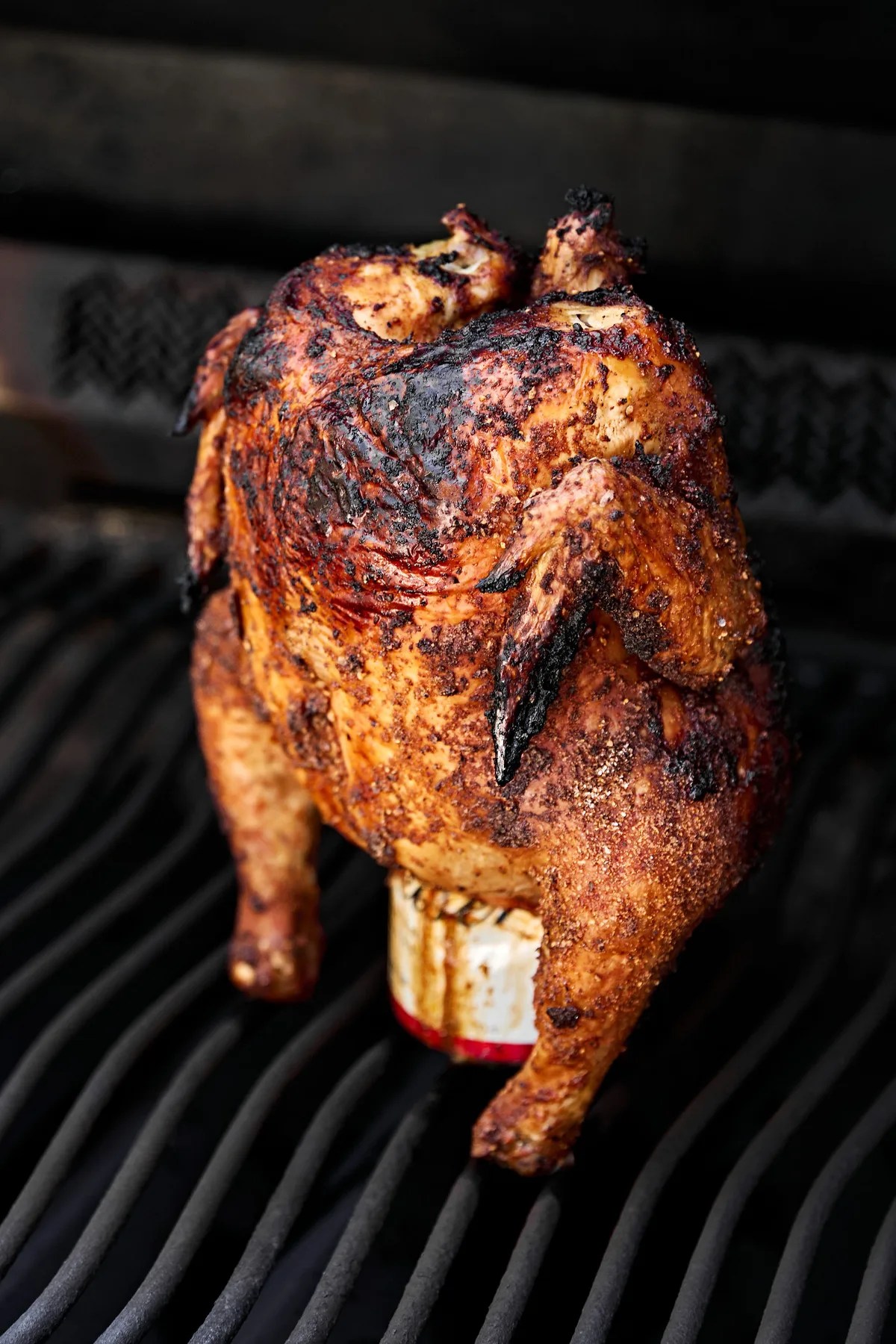
Beer can chicken

The collaboration between the manufacturers of Pringles and Miller Lite is an example of what is called co-branding (sometimes called cross-branding). In a paper published in the International Journal of Consumer Studies, Ceyda Paydas Turan of the University of Surrey in England, defined co-branding as “a marketing strategy in which two or more brands are presented simultaneously to the consumer as one product to create a sum of brand assets, that is greater than that of the individual brands” Turan goes on to state that “the purpose of forming a co-brand is to create synergies, boost awareness and enhance the value of the brands involved by leveraging each brand through the transfer of associations from one brand to the other and differentiating them from the competition.” Put more simply, co-branding allows companies to tap into each other’s customer base, thus raising awareness of each brand to a potentially new audience. Enhanced customer awareness should result in increased sales.

Co-branding is quite common. For example, for many years American Express has teamed up with Delta Airlines to offer their customers the Delta Sky Miles American Express card. Earlier this year, Jackson Family Wines partnered with the National Basketball Association to co-brand three wines from its Kendall-Jackson range. Also, earlier this year, Uber entered into a co-branding partnership with Gemini Trains, one of the companies offering train service between the United Kingdom and France via the Channel Tunnel.

While many co-branding partnerships are successful and reap benefits for the companies involved, there have been some high-profile failures. Take the co-branding partnership between Lego and Shell. The benefits to both were obvious. Lego gas stations, trucks, and racing cars bearing the Shell logo put the brand in front of both current (parents) and future (children) drivers, while the toymaker’s Shell-branded products were available for sale at the oil giant’s gas stations in over two dozen countries. As a result of a campaign by Greenpeace, however, in which the environmental activist group argued that it was inappropriate for a children’s toy maker to partner with an oil corporation, Lego made the decision in 2014 to end its partnership with Shell.

One of the ways to measure the success of a co-branding initiative is how consumers judge and evaluate the co-branded product. At the time of writing, consumers gave the Miller Lite Beer Can Chicken a score of 3.4/5, with 52% recommending the product. Of the 40 reviewers, 19 gave it 5 stars, while 12 gave it 1 star. With 31 of the 40 reviews being either 1 or 5 stars, it suggests that consumers either loved the product or hated it.

Consumer reviews reflected this range of opinion, ranging from:

“I think they’re actually very good, like the flavor and the minimal amount of saltiness. Like not overpowering in any way but a solid, good flavor”,

“No idea who said this was anywhere near beer chicken, but it’s not. If La Croix made chips, it would be this. Severely lacking in accuracy and flavor profile as advertised.”

Interestingly, on the back of the can there is a statement that declares that the “product does not contain alcohol”. Despite this fact, an additional statement notes that “this licensed product is intended for adults of legal drinking age”.

Beer can chicken Pringles – does not contain alcohol; intended for adults of legal drinking age

Occasionally, when doing research for one of my blog entries, I end up down an internet rabbit hole. This happened on this particular occasion. So, I want to shift gears a little and say a few words about the design of the iconic Pringles can itself. It was co-invented by Fredric J. Baur and Harold Kenneth Hawley, organic chemists and food storage scientists who worked for Procter and Gamble (P&G) the Cincinnati-based producer of Pringles. Baur was born in Toledo, OH – my current city of residence – on July 14, 1918. He attended and graduated from The University of Toledo – my current place of employment – before going to The Ohio State University where he completed both a master’s and PhD in organic chemistry. Baur started working for P&G in the late 1940s, retiring in the early 1980s. In 1966, Baur and Hawley applied for a patent for the can they had designed to hold Pringles. Their patent was approved in 1970.

Fredric Baur, co-inventor of the Pringles can
Baur and Hawley’s patent for the Pringles can was approved in 1970

Bauer died in Cincinnati, OH on May 2008 at the age of 89. At his request, some of his ashes were deposited in a Pringles can and then buried. As I reflected on Baur’s ashes being pIaced in a Pringles can a thought crossed my mind – did the suburban Cincinnati funeral home responsible for handling Fredric Baur’s funeral miss out on a great co-branding opportunity?


Further Reading:

Turkmen, Ceyda Paydas. 2021. Successful drivers of co-branding: A meta-analysis. International Journal of Consumer Studies, Volume 45, Issue 4, Pages 911-936.

A Taste of Place

In 2009, Amy Trubek, published her book The Taste of Place: A Cultural Journey into Terroir“. Trubeks’ book is about food. In particular, it is about local food and its connection to place.

One of the concepts that Trubek discusses at some length in her book is that of terroir. You may be familiar with this concept, but if you are not, the Merriam-Webster Dictionary defines terroir as “the combination of factors including soil, climate, and sunlight that gives wine grapes their distinctive character”. While it is a concept most commonly used within the wine industry, it is being increasingly used in discussions taking place around the craft beer. For example, a number of scientific studies show that the same hop varietal grown in two different places will exhibit different taste and aroma characteristics. A study conducted by scientists at Oregon State University showed that “Cascade hops grown in Oregon were characterized by strong citrus, floral, fruity, herbal and resinous aroma. Cascade hops from Washington displayed more tropical and sweaty aroma”. These findings have been replicated in numerous other studies, including one conducted in Italy. The reasons for these differences are quite simple, different soils and micro-climates impact hops differently. As noted by the Italian researchers, “the differences found in the hops were reflected in the beers, which were clearly recognized as distinct by a sensory panel.” In short, hops have terroir.

Approximately, 95% of all hops harvested in the United States are grown in the Pacific Northwest (PNW) states od Washington, Oregon, and Idaho. The growth of craft breweries, however, has resulted in farmers outside of the PNW experimenting with hops as a crop. Their primary customers are local breweries. Hops are now grown in 30+ states outside the PNW. This provides beer drinkers in states such as California, Michigan, and Ohio to taste beer with locally grown hops. And, because of terroir, one can make the case that they are experiencing a s taste of place.

But hops are not the only local crop being used in the brewing of craft beer. Other locally sourced crops are also commonly used. Earlier this spring, I enjoyed a basil honey ale at one of my local breweries, Earnest Brew Works, whose ingredients included locally grown basil. Other examples from across the country abound. Island Brewing Company in Carpinteria, CA brew an avocado honey ale using locally sourced avocados, while Cape May Brewing Company of Cape May, NJ use local beach plums in the making of their Beach Plum IPA.

This basil honey ale from Earnest Brew Works in Toledo, OH included locally grown basil as one of its ingredients.

Some breweries also forage for local ingredients to include in their beer. Foraging simply means “searching for potable ingredients from one’s own property, nearby park or forest, or even neighbors’ backyards” and harvesting these ingredients by hand. For example, Matt Hofmann, the founder of Sahale Ale Works in Grafton, WI brewed a farmhouse ale that included dandelion heads from a nearby nature preserve. In 2015, Bob Kunz, the owner of Highland Park Brewery in Los Angeles, CA produced a Saison using fruits and herbs (lemongrass, sour flower and a half-dozen varieties of lemons and limes) foraged from the back yards of both him and his neighbors. The Saison is appropriately called Yard Beer.

On a recent trip to Italy, I had an opportunity to enjoy another taste of place. I was attending a local food and beer festival in the small town of Lecce nei Marsi (population 1,694) in Italy’s Abruzzo region. One of the local beers available at the festival was an English Browm Ale whose ingredients included the faggiola – beech nuts from local beech trees. The beer, Moricento, is brewed by Beer Park Brewery. What makes Moricento special, at least in my eyes, is that the beech nuts come from ancient beech trees that are located in a UNESCO World Heritage site.

Beechnuts are an ingredient in Moricento English Brown Ale
Moricento – a beer whose ingredients include beech nuts

Lecce nei Marsi is located in the Abruzzo, Lazio and Molise National Park. The park covers 50,000 hectares, 60% of which is covered by beech forests. As noted above, the beech forests in the park are a UNESCO World Heritage Site. This is a somewhat an unusual World Heritage site, as it is part of a chain of beech forests that are spread across eighteen European countries. According to UNESCO, these “ancient beech forests are primeval beech forests that have changed very little over the centuries, because they are preserved in areas that are difficult to reach and because beech trees easily adapt to diverse climatic and geographical conditions. Among the various specimens, there are beech trees over 500 years old”. Thus, when you taste Moricento, you might argue that not only are you sampling a taste of place, but perhaps also a taste of the region’s natural history.

The ancient beech forests of Europe (Source: UNESCO)
Enjoying a taste of Moricento beer at the local food and beer festival in Lecce nei Marse

Further Reading

Carbone, Kayta, Giulia Bianchi, Maurizio Petrozziello, Federica Bonello, Valentina Macchioni, Barbara Parisse, Flora De Natale, Roberta Alila, and Maria Carla Cravero. 2021. Tasting terroir through craft beer: Quality and sensory assessment of cascade hops grown in central Italy and derived monovarietal beers. Foods, Volume 10, Issue 9.

Britain’s Desi Pubs

Last month I participated in an online webinar on “Public House: The Culture and Society of the London Pub“. It was organized and hosted by the The Society of Architectural Historians of Great Britain, an organization which brings together academics, architects, heritage experts, and others with an interest in the history of the built environment. The presentation on London pubs was made by Dr David Knight of the Royal College of Art in London. During his presentation, Dr Knight identified over a dozen different types of London pub. Some types, such as Coaching Inns, no longer exist, while others such as the Community Pub are alive and well. Of the different types of pub that Dr Knight mentioned during his presentation, one in particular peaked my curiosity – Desi Pubs. When I first saw the term I thought that perhaps “Desi” was short for “Destination” and that a Desi Pub was a type of pub that was a destination for visitors to a city – for example, The Temple Bar in Dublin, Ireland. As it turns out, I was wrong in my assumption. A Desi Pub is, in fact, a colloquial term for a pub which is owned or managed by a landlord of Indian origin. In a Desi Pub, along with traditional English Ale, you can enjoy a lunch comprising traditional Indian cuisine. This got me curious, so I thought I’d do some research into the origins and current status of Britain’s Desi pubs.

Desi Pubs have their origins in the 1960s, and were primarily a response to racism experienced by British Asians. Desi Pubs provided a “safe space” where British Asians could enjoy a couple of pints of beer, and some traditional (primarily Punjabi) cuisine, without fear of harassment. This harassment was experienced first hand by the American civil rights activist, Malcom X, who visited the Blue Gate pub in Smeth

The term “Desi” means “local“, “home”, or “from the country” and is geographically linked to the south Asian countries of India, Pakistan, and Bangladesh. There are over 4.3 million individuals of Asian ancestry living in the UK. This constitutes 7% of the U.K. population, making them the second largest ethnic/racial group after Whites. Most of Britain’s Asian residents have their family roots in India, Pakistan, and Bangladesh. British residents of Indian, Pakistani, and Bangladeshi origin constitute 2.3%, 1.9%, and 0.7% of Britain’s population respectively. India’s Punjab region, Pakistan’s Mirpur District, and Bangladesh’s Sylhet region, in particular, were the main sources of Asian migrants to Britain in the post-1947 period. Britain, of course, developed strong ties with the Indian sub-continent as a result of both trading and its colonial exploits. Post World War II labor shortages in the United Kingdom provided an opportunity for Indians, Pakistanis, and Bangladeshis who sought a better life outside of their country of birth.

As a student at the University of Glasgow, Scotland between 1981 and 1985, I was well aware of the presence of the city’s Pakistani and Indian populations. Indian restaurants were (and still are) numerous and hugely popular and were often my restaurant of choice before heading our for an evening of drinking beer with friends. Newsagents and convenience stores, many owned by Pakistanis, were equally ubiquitous. Every Wednesday, I’d pop into the same one and purchase a copy of The Celtic View, the weekly newspaper of the soccer team I supported. It was only after doing this for a couple of months that I discovered that the owner of the store, Hassan, supported Celtic’s arch enemies, Rangers. After that discovery there was a lot of friendly banter back and forth between myself and Hassan every time I frequented his store. But I digress.

Curry is an enormously popular dish in the United Kingdom, so much so that so that it has been dubbed the “UK’s adopted national dish”. In 2001, the then British Foreign Secretary, Robin Cook, referred to Chicken Tikka Massala (chunks of chicken in a spiced curry sauce) as “a true British national dish“. There are an estimated 12,000 curry restaurants (often referred to as curry houses) in the United Kingdom, employing somewhere in the region of 100,000 people. Such is the importance of curry to British culture that in 2015, the British Parliament established a British Curry Catering Industry All-Party Parliamentary Group, whose purpose is to “provide a forum for parliamentarians to consider and discuss the role and contribution of the British curry catering industry”.

While many curry houses are branded as “Indian” restaurants, most are in fact owned by immigrants and/or their descendants from Bangladesh. Indeed, between 80% and 90% of British curry-house owners can trace their roots back to the Bangladeshi city of Sylhet. The Red Lion is one example of a Desi Pub. Located in Birmingham, England it has been in the hands of the Purewal family since 1997. The Red Lion website emphasize the quality of their food, noting that “the standard of food matches that of high end Indian restaurants”. The Red Lion also boasts that “our chefs are well experienced, coming from some of the top restaurants in India”.

Part of the Red Lion’s menu

While the clientele of Britain’s original Desi Pubs were primarily from Britain’s Asian community, today they function as integrated, multi-ethnic, spaces. One observer notes that Desi Pubs are “a celebration of multiculturalism . . . offering Indian food to white and brown customers alike”, while another suggests that they are an “East meets West story, where the classic English pub with its ale, darts and dominoes meets Punjabi food and Bhangra”. According to Bera Mahli, who runs the Red Cow and Grill in Smethwick (just outside Birmingham) with his brother Gamy, “the curries served up in old boozers are now bringing people together in a positive way – rather than be used as a negative marker to highlight racial differences.”

Some Desi Pubs have become what are termed Third Places (community gathering places).  The aforementioned Bera Mahli observes that, “the pub is more a community centre than anything else – for everyone.  One of the big changes is seeing Asian families in the pubs. Back when I was younger,  pubs in the Indian community were just for men only. These days as they are no longer places just to drink,  we have Asian girls, aunties and grandmas”. The aforementioned Red Lion pub in Birmingham promotes itself as “an easy going and family friendly pub

For several decades, the United Kingdom has seen a decrease in the number of pubs, as closures have outnumbered openings. A 2014 report showed that the United Kingdom had lost around 21,000 pubs since 1980, with most closures having occurred since 2006. Reasons for this decline include the smoking ban, increased taxation on alcohol, and a reduction in alcohol consumption. Many of Britain’s Desi Pubs are former pubs that had closed and have, in fact, been resurrected by their Asian owners. In addition to saving some old British pubs, the owners of the Desi Pubs may become one of the last bastions of authentic Indian cuisine. The authenticity of the great British curry is under attack.

Food For Thought

img_3845
Enjoying a beer at the Mad Anthony Brewing Company in Fort Wayne, IN

img_3846
Lansing Brewing Company in Lansing, MI

dscn3158
The Vierling Restaurant and Marquette Harbor Brewery in Marquette, MI

According to the Brewers Association most Americans live within ten miles of a craft brewery. While I have been aware of this fact for some time it really struck home earlier this summer when I was returning home from a family wedding. The wedding was in Noblesville, IN which is about three hours and fifteen minutes southwest of Toledo by car. The wedding was on a Saturday afternoon and so we stayed overnight in nearby Fishers, IN and drove home the next day. Before we left to drive Continue reading Food For Thought