It is a tradition that my last blog entry of the year reflect upon the previous twelve months with a photo gallery of the breweries I visited during that period. In 2026, I visited a total of 35 breweries- 15in my home state of Ohio, 14 in other states, and 6 outside of the United States. The 14 breweries I visited in other states were located in California, Colorado, Michigan, Pennsylvania, and Utah, while those outside of the United States were in Armenia, Canada, Poland, and Slovakia. Of the 34 breweries 21 were ones I had visited before and 14 were first time visits (indicated in bold in the list below).
As per tradition, following the list below, I have included one photograph from each of the breweries I visited. Enjoy.
OHIO (15)
60cc Brewing, Toledo, OH
BJ’s Restaurant & Brewhouse, Toledo, OH
CLAG Brewing Co. Sandusky, OH
Great Black Swamp Brewing Co., Toledo, OH
Hoptometry Brewing, Tiffin, OH
Inside the Five Brewing Company, Sylvania, OH
Inside The Five Brewing Co., Toledo, OH
Inside the Five Brewing Co., Perrysburg, OH
Jackie O’s Pub and Brewery, Athens, OH
Maumee Bay Brewing Co., Toledo, OH
Old Dog Alehouse & Brewery, Delaware, OH
Patron Saints Brewery, Toledo, OH
Quenched & Tempered Brewing Co. Toledo, OH
The Laird Arcade Brewery, Tiffin, OH
Voodoo Brewing Company, Toledo OH
REST OF UNITED STATES (14)
Bell’s Eccentric Cafe, Kalamazoo, MI
Blind Lady Ale House, San Diego, CA
Dark Horse Brewing Company, Marshall, MI
Gordon Biersch Brewing Company, Romulus, MI (Airport Location)
Harland Beer Co., San Diego, CA (Bay Park Location)
Red Rock Brewery, Salt Lake City, UT (Airport Location)
New Holland Brewing Co., Battle Creek, MI
North Park Beer Co., San Diego, CA (North Park Location)
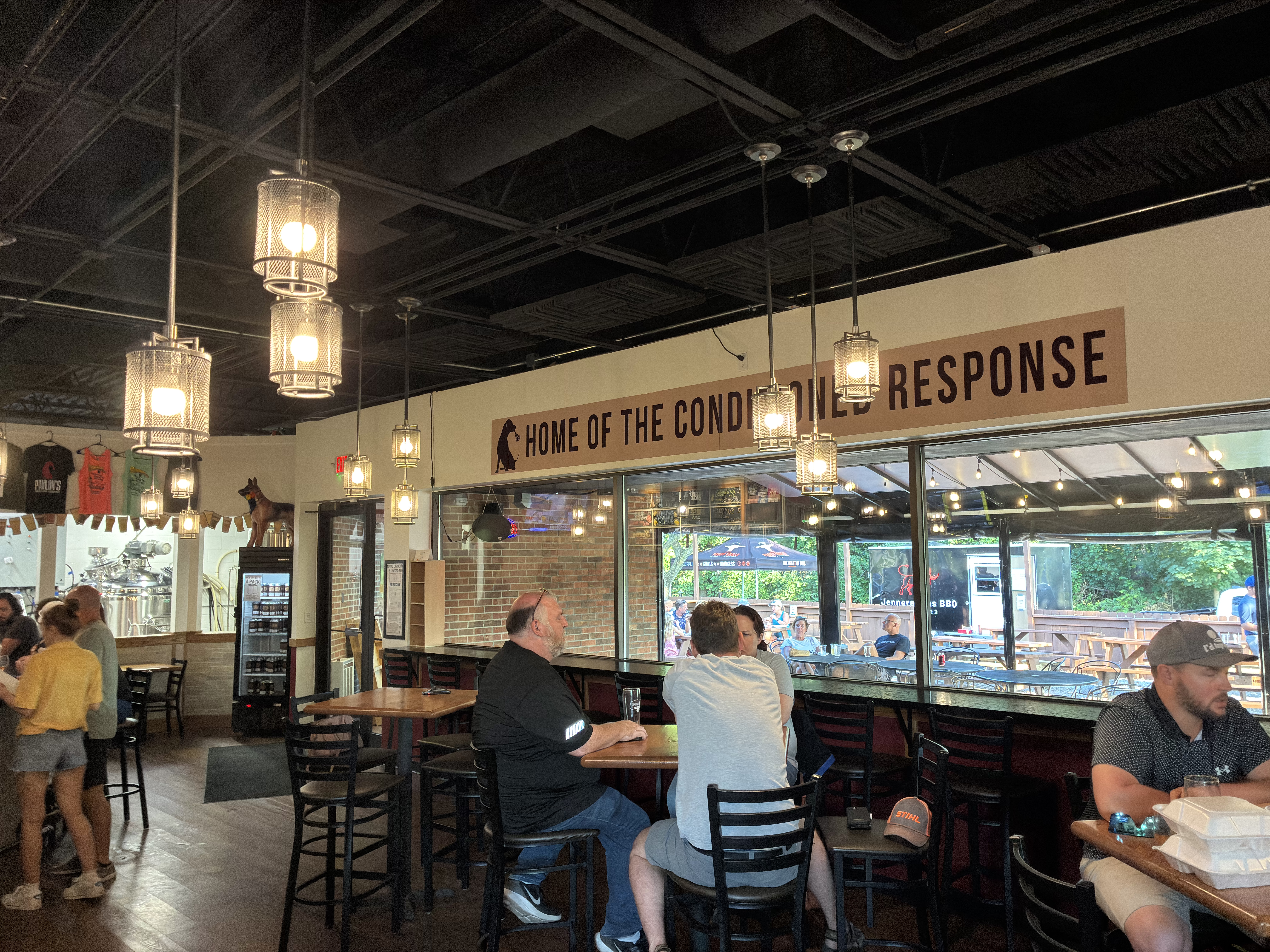
Pavlov’s Brewing Co., Temperance, MI
San Diego Tap Room, San Diego, CA
Seek Beer Co., San Diego, CA
Stone Brewing, San Diego, CA (Airport Location)
Vault Brewing Company, Yardley, PA
Woods Boss Brewing Company, Denver, CO
INTERNATIONAL (6)
Beer Academy Ethnograph, Yerevan, Armenia
Brovaria, Poznan, Poland
Pivovar Golem, Košice, Slovakia
Pivovar Hostinec, Košice, Slovakia
Steamworks Brewing Co., Vancouver, Canada
Yaletown Brewing Company, Vancouver, Canada
60cc Brewing, Toledo, OH
Beer Academy Ethnograph, Yerevan, Armenia
Bell’s Eccentric Cafe, Kalamazoo, MI
BJ’s Restaurant and Brewhouse, Toledo, OH
Blind Lady Ale House, San Diego, CA
Brovaria, Poznan, Poland
CLAG Brewing Co., Sandusky, OH
Dark Horse Brewing Company, Marshall, MI
Gordon Biersch Brewing Company, Romulus, MI (Airport Location)
Great Black Swamp Brewing Co., Toledo, OH
Harland Beer Co., San Diego, CA (Bay Park Location)
Hoptometry Brewing, Tiffin, OH
Inside The Five Brewing Co., Sylvania, OH
Inside The Five Brewing Co., Perrysburg, OH
Inside The Five Brewing Co., Toledo, OH
Jackie O’s Pub and Brewery, Athens, OH
Maumee Bay Brewing Co., Toledo, OH
New Holland Brewing Co., Battle Creek, MI
North Park Beer Co., San Diego, CA (North Park Location)
Old Dog Alehouse & Brewery, Delaware, OH
Patron Saints Brewery, Toledo, OH
Pavlov’s Brewing Co., Temperance, MI
Pivovar Golem, Košice, Slovakia
Pivovar Hostinec, Košice, Slovakia
Quenched & Tempered Brewing Co. Toledo, OH
Red Rock Brewery, Salt Lake City, UT (Airport Location)
San Diego Tap Room, San Diego, CA
Seek Beer Co., San Diego, CA
Steamworks Brewing Company, Vancouver, Canada
Stone Brewing, San Diego, California (Airport Location)
Between 2017 and 2021, at the end of each year, I posted a blog entry documenting all the breweries I had visited during the calendar year. Included was one photograph from each brewery. In 2022, I did not post such an entry. I can’t quite remember why this was the case. However, I also failed to make an end-of- year posting in 2023. Anyway, 2024 is almost over and I thought I’d get back into the habit of documenting the breweries I visited.
During 2024, I visited a total of forty-five breweries. Before going any further, I should define what I am counting as a brewery. Any establishment owned by a brewery, whether beer is brewed on-site or not, is included in my list. For example, Inside The Five Brewing Company has three locations in northwest Ohio. At only one of those locations is beer brewed. However, all three locations are included in the list of breweries I visited in 2024.
Of the forty-five breweries I visited in 2024, eighteen were in my home state of Ohio, seventeen were located elsewhere in the United States, and ten were outside of the United States. Of the seventeen breweries I visited elsewhere in the United States, four were in the neighboring state of Michigan. Toledo, where I live, is located just south of the Ohio/Michigan border, so visits to Michigan breweries are fairly routine. Trips to California, Indiana, Nevada, and Pennsylvania afforded me the opportunity to visit breweries in those states. In terms of breweries outside of the United States, two trips to Canada, as well as trips to Armenia and Slovakia, meant that I visited more non-US breweries than I normally do.
Of the forty-five breweries I visited, sixteen were repeat visits. This meant there were twenty-nine breweries that I visited for the first time (indicated in bold font in the list below).
I hope you enjoy the photographs below. I wish every one a Happy New Year and hope that 2025 is a wonderful year for you.
OHIO (18)
60CC Brewing, Toledo, OH Arlyn’s Good Beer, Bowling Green, OH
In October, I spent 4 days in Osnabrück, Germany. I was there attending the annual conference of the International Geographical Union’s Commission on the Dynamics of Economic Spaces. I flew into Frankfurt – there is a direct flight from Detroit – and then took the train to Osnabrück. It was a 3.5-hour train journey from Frankfurt Airport to Osnabrück.
Osnabrück, with a population of just over 168,000 is in Lower Saxony. Historically, it is famous for being one of the cities (the other being Münster) where the Peace of Westphalia was negotiated, thus ending the Thirty Years’ War (1618–1648). As a result of its part in these negotiations, the city adopted the title Friedensstadt (“City of Peace”). The city was heavily bombed during the Second World War, requiring large parts of it to be rebuilt. Today, Osnabrück is a welcoming and vibrant city, and a great place to spend a couple of days.
Inside Osnabrück City Hall where the Peace of Westphalia was negotiated
I arrived in Osnabrück in the afternoon before the start of the conference and thought that this would be an ideal time to visit the city’s only brewery – Hausbrauerei Rampendahl. The brewery was one of the few buildings in Osnabrück to avoid damage during the Second World War.
Hausebrauerei Rampendahl
Hausebrauerei Rampendahl
Like most German breweries, the beers at Rampendahl are brewed in accordance with the German Purity Law (the Reinheitsgebot) of 1516. This means that all of Rampendahl beers contain only four ingredients – water, barley, hops, and yeast. On the evening that I visited, three different beers were available – a Dunkel Lager, a Weizen (Wheat), and a Helles Lager. Needless to say, I tried all three. Having only three of the brewery’s beers to choose from was something of a different experience from the vast choice that is available at most American craft breweries that I visit. I am not sure if such a limited range of beer styles is common in German breweries, or if this was simply an exception. Perhaps one of my readers with knowledge of German breweries can answer this question for me. As I write this entry, on its website the brewery lists four beers that it has available – Rampendahl Special, Rampendahl Hell, Rampendahl Wheat, and Rampendahl Maibock.
Dunkel Lager
Weizen
Helles Lager
The brewery’s website has a short history of the brewery. The translation from German to English is such that it is difficult to clearly identify brewery’s back story. It appears that it may have once been a townhouse. The date of the building’s construction is not listed, but at least part of the building dates to 1177. Assuming this to be correct, the date at which it became a brewery is not provided. The brewery got its name from a group of disgruntled citizens, who called themselves the Rampendahl Society. Rampendahl was the owner a local restaurant where the Society met to discuss their grievances over beer and wine. In 1430, the Society led an uprising against Osnabruck’s elite (wealthy merchants). The nature of their grievances is not specified, but the uprising failed, and its leaders executed.
As I noted above, I was in Osnabrück to attend a conference. As part of the conference, we had dinner in a venue called Lagerhalle. The literal translation of “Lagerhalle” is “Warehouse”. Lager, of course is one of the two main types of beer (the other being Ale). The word Lager is a German word, which means “to store“. Lager can take between 4 and 8 weeks to produce, during which time it has to be stored (a stage in the brewing process called lagering) at the appropriate temperature. The Lagerhalle, where we had dinner is a community cultural venue and event space which puts on a wide variety of programing, including cinema, theatre, cabaret, lectures etc. Housed in a former hardware warehouse. the use of Lagerhalle as a community center dates from the mid-1970s and was a response to the youth center movement that swept Germany at that time.
Lagerhalle in Osnabrück
Finally, during one of my walks through the streets of Osnabrück, I came across Bierstraße (Beer Street). Given Germany’s love of beer (its citizens consume over 90 gallons per capita per year) it should not be surprising to see a street in a small German city thus named.
I was in Napa, CA recently. To get to Napa, we (me, my wife, youngest daughter, and son-in-law) flew into San Francisco, CA, rented a car, and drove north. On our return trip home we decided to spend a day in San Francisco before catching our flight the next morning. When we knew that we were going to spend some time in San Francisco, I had one destination in mind – Anchor Brewing.
Any craft beer drinker worth his or her salt knows of Anchor Brewing. It’s status among American craft breweries is legendary and iconic. For those of you unfamiliar with its story and historic significance, here is the CliffNotes version.
In 1871, Gottlieb Brekle, a German immigrant purchased an old beer and billiards saloon on San Francisco’s Pacific Street. He transformed it into a brewery. It was not called Anchor back then. The Anchor name did not materialize until 1896 when, another German brewer, Ernst F. Baruth and his son-in-law, Otto Schinkel, Jr., purchased the brewery and called it Anchor. In the years that followed, Anchor Brewing faced and overcame a number of challenges. In 1906 the brewery was destroyed by a devastating fire; the fire being the result of the great San Francisco earthquake. A new Anchor Brewery was built, on Market Street. In 1920, Prohibition arrived. Unlike many breweries across the country, Anchor opted not to produce alternative products (e.g., ice cream or soft drinks) during Prohibition. The brewery sat idle. In 1934, Anchor Brewery suffered another fire. Once again, a replacement brewery was constructed; this one being only a few blocks from Anchor’s present-day location. In 1959, Anchor Brewery was shut for a brief period by its then owners, Joe Allen and Joe Krause. In 1960, the brewery was as purchased and reopened by Lawrence Steese. But these proved challenging times for a small brewery like Anchor. Mass produced lighter lagers were growing in popularity, and Anchor struggled to retain accounts and maintain sales. By 1965, Steese was ready to close down Anchor Brewing. Enter stage left, Fritz Maytag.
Fritz Maytag is the great-grandson of Fred Maytag, founder of the Maytag Corporation. Fritz was a big fan of the beer brewed at Anchor Brewery. So when he heard that it was going to close, he decided to do something about it; he purchased a fifty-one percent share in the brewery. With that single act, and the subsequent success of Anchor Brewery, Maytag has become known to many as the “Godfather” of craft beer. Maytag revitalized the brewery. Both its portfolio and sales of beer expanded. Such was Anchor’s success that by the late-1970s, they were looking for a new production facility. In 1979, the moved into their current home on Mariposa Street. The building, had started life as a coffee roasters in 1937. In 2010 Maytag retired, selling the brewery to Keith Greggor and Tony Foglio. In 2017, Anchor Brewing was sold to the Japanese brewing giant Sapporo. The purchase price was a reported eighty-five million dollars.
Maytag’s influence on craft brewing extended well beyond what he achieved at Anchor. Maytag assisted other prospective craft brewers and was thus instrumental in assisting the broader growth of the fledgling craft brewing industry. In a 2015 paper, published in the Journal of Wine Economics, Kenneth G. Elzinga, Carol Horton Tremblay, and Victor J. Tremblay, observe that “many early entrants clustered near Anchor Brewing to learn the art of craft brewing from Maytag . . . several of the pioneers in craft brewing were in geographic proximity to Maytag’s operation, visited his facility, and learned (and received encouragement) from him.”
The Anchor Brewery on Mariposa Street
Anchor offers guided tours of its brewery, so we signed up for one. The cost was $25 per person. We arrived at the brewery several hours before our tour time. This gave us time to have lunch. We found a couple of lunch options within walking distance of the brewery, and decided upon Dos Piñas Taqueria. As I was standing in line waiting to order our food, I noticed a poster on the wall that stated, “We support Anchor Steam Workers”. Six days prior to our tour of the brewery, the members of a worker’s organizing committee had delivered a letter to the Anchor management requesting that they formally recognize an employees’ union.
Poster supporting Anchor Brewery workers at Dos Piñas Taqueria
Following lunch we headed over to Anchor Public Taps, the taproom across the street from the main production brewery. In addition to being a taproom, Anchor Public Taps is a pilot brewery, where a number of small batch beers are produced. These are available exclusively for sale in the taproom. I opted for Dank Denali, a session IPA.
Anchor Public Taps is across the street from the main Anchor Brewery. Inside Anchor Public Taps Anchor Public Taps includes a pilot brewery, whose beers are exclusively available at the taproom
After Anchor Public Taps, it was time for our tour of the main production brewery. After entering the brewery we were greeted at the brewery’s bar by what would be our friendly and highly informative tour guide, Pedro. Pedro provided us with a history of Anchor Brewery and a sample of the brewery’s signature product, Anchor Steam. First brewed in 1896, Anchor Steam is widely recognized today as an iconic American beer. After an overview of Anchor’s history, Pedro offered us another beer (I opted for their Anchor Porter) and, with brew in hand, we started our tour of the brewery. The tour was, in many ways, a typical brewery tour. We learned about the brewing process and saw where the magic happened. Buy this was not a typical brewery. This was an iconic brewery, and the building for me constituted something of a sacred space. It was not the original space occupied by Anchor. Nor was it the original space purchased by Fritz Maytag. But it was a space that Anchor now occupied. It was a space that represented and symbolized a revolutuon; a revolution in which ordinary beer drinkers stood up and declared, with a certain conviction, that ‘we can do better’. And it was a conviction upon which many acted, witness the seven thousand plus breweries that dot the American landscape today.
Our highly likeable and informative tour guide, Pedro, tells us about the history of the brewery Fritz Maytag and Anchor Brewery have an important place in American craft brewing history Pedro telling us about the brewing processOpen fermentation tanks Northern Brewer hops – the only hop used in Anchor Steam beer
So another year is about to draw to a close. And with that, it is time to look back on my brewery visits for the year. This year, I visited a record sixty-six breweries. At the start of the year, I set myself a goal of fifty-two breweries, an average of one per week. So I more than met my target.
Of the breweries that I visited, twenty were in my home state of Ohio, forty-one were in states other than Ohio, and five were outside of the United States. In addition to Ohio, I had the opportunity to visit breweries in five other states – Kentucky, Michigan, Missouri, Oregon, and Texas. Outside of the United States, I visited breweries in Italy, Ireland, and the United Kingdom.
Of the sixty-six breweries that I visited, I had been to thirteen of them at least once before (indicated in italics in the lists below), which means there were fifty-three breweries that I visited for the first time.
This year, I also kept track of the craft beer bars that I visited. Throughout the year, I visited nine craft beer bars – three in Austin, TX, and one each in Toledo, OH and Ann Arbor, MI. I also visited craft beer bars in Rome (Italy), Lisbon (Portugal), Zurich (Switzerland), and Innsbruck (Austria).
Creating a list of craft beer bars visited did raise some interesting definitional questions. To qualify as a craft beer bar, does that mean that all beer that it sells must be craft beer? If not, what proportion of the beer must be craft beer? Does a bar that sells predominantly macro-beer, but has a couple of craft beers on tap, qualify as a craft beer bar? I did give this some thought as I set out to create this list. Here is where I ended up, from a definition perspective. To qualify as a craft beer bar, the beers available must be predominantly craft beers. It is ok to have one or two macro-beers, but no more than that. Also, it must have craft beers from more than one brewery. For example, while most of the beers available at the Brewdog bar in Rome are brewed by Brewdog, the bar does have a nice, albeit, small selection of other craft beers. While you may debate the criteria I used to define a craft beer bar, it worked for me.
Below you will find a list of all the craft breweries and craft beer bars that I visited during 2018. Following this list, you will find one photograph from each of the places that I visited. I hope that you enjoy these. They are intended to capture the beauty and diversity of craft beer.
For 2019, I will once again set a target of fifty-two craft breweries. While I am tempted to try to beat my 2018 total of sixty-six breweries, I want to keep this a fun, non-stressful, venture – fifty-two seems a reasonable target.
This is the time of year when many people reflect about the year that is coming to an end. So as I was thinking about a topic for my final blog entry of 2017, I thought I’d compile an inventory of the
breweries I visited during the last twelve months.