Category Archives: Craft Breweries

A Glass Half Full Revisited: When Demographic Momentum Stalls

In May 2015, I published a blog post titled A Glass Half Full?” The piece was inspired by a simple yet intriguing question a colleague posed while we were enjoying a couple of beers together at the Delirium Cafe in Amsterdam: How large a share of the American beer market might craft brewers ultimately capture?

Toward the end of that blog entry, I offered my response. And here it is:

Well I am not going to be nailed down to a specific market share. However, with demographic momentum working in their favor, capturing somewhere between 40% and 50% of the market (as currently defined) by 2035 is not unreasonable. Of course I may be wrong.

Oh boy, was I wrong. Even though 2035 is still nine years away, it’s already clear that my prediction is unlikely to come close. Back in 2015, when I made it, craft breweries had already captured 19.3% of the American beer market – measured in dollar sales, not volume. Today, that share sits at 24.6%. That’s an increase, but hardly the dramatic surge I had anticipated when I offered that bold forecast eleven years ago. So, what went wrong?

Before addressing that question, it is worth revisiting the context behind my original prediction. Between 2010 and 2014, the number of craft breweries in the United States grew from 1,758 to 3,968 – an increase of ~125 percent. Over the same period, craft beer’s share of the U.S. beer market rose from 7.6 percent to 13 percent, a gain of 71 percent. By any reasonable measure, the industry was in the midst of an unmistakable boom.

In recent years, however, that boom has become something of a bust. Between 2020 and 2024, the number of craft breweries in the United States increased from 8,921 to 9,769, an increase of just 9.8%. Over the same period, craft beer’s market share increased from 23.7% to 24.7%. an increase of 4.2%. Taken together, these trends suggest that the American consumer’s appetite for craft beer has largely stalled.

Towards the end of my 2015 blog entry, I made the observation that my bold forecast hinged very much upon “the next generation of beer drinkers preferring craft over traditional beer” and that “preferences sometimes have a habit of changing with generational shifts”. How true this turned out to be.

It was Millennials – those born between 1981 and 1996 – whose outsized enthusiasm for craft beer powered the segment’s extraordinary expansion. Unfortunately, for craft brewers at least, it was an enthusiasm not shared by Generation Z – those born between 1997 and 2012.

It is well documented that members of Generation Z are drinking less alcohol. Writing for USA Today, Betty Lin‑Fisher characterizes this shift as Gen Z “ghosting” alcohol, noting that a desire to lead a healthier lifestyle is a key motivating factor. Survey data from Gallup in 2025 support this interpretation: 66% of Americans aged 18–34 reported that they viewed moderate alcohol consumption – defined as one or two drinks per day – as harmful to personal health. By comparison, this view was held by 50% of adults aged 35–54 and 48% of those aged 55 and older. A 2021 study in JAMA Pediatrics reported that 28% of college students abstained from alcohol in 2018, up from 20% in 2002. It is important to note that concern about the health impacts of alcohol has been increasing across all age groups in recent years, suggesting that changing attitudes toward drinking are not confined to younger generations alone.

Growing interest in healthier lifestyles – and a deliberate move away from alcohol – has given rise to initiatives such as Dry January and Sober October, while also adding new terms like sober curious to the popular lexicon. These shifts are not confined to the United States. Declining alcohol consumption has been documented across a range of advanced economies, including Australia, Ireland, and Japan. Even Germany – long regarded as a stronghold of beer culture – recorded its steepest drop in beer sales in more than three decades in 2025.

Many people who are cutting back on alcohol still want beverages that deliver beer’s familiar flavors. This preference has helped fuel rapid growth in the non‑ and low‑alcohol beer segment. In the United States, sales of non‑alcoholic beer rose by 23 percent between January and August 2025. Although non‑alcoholic beer still accounts for only about 1.3 percent of total beer sales, the category has become large enough to support major players. Athletic Brewing Company, which produces only non‑alcoholic beer at its breweries in Milford, Connecticut, and San Diego, California, now ranks as the sixth‑largest craft brewery in the United States.

Although much of the existing evidence points to declining alcohol use among Gen Z, a recent IWSR survey suggests the trend may not persist. In the United States, the share of legal drinking age (LDA+) Gen Z adults reporting alcohol consumption in the past six months increased from 46% to 70%. While this is quite a large change over a very short period, one expert suggests that this may be indicative of longer-tern trends and that as Gen Z age and gain greater disposable income, their drinking patterns may increasingly resemble those of older generations. Writing for the Pew Research Center on generational differences in values and behaviors, Michael Dimmock cautions that “don’t assume that what you see today is what you’ll get tomorrow.” In other words, change happens.

When all is said and done, this retrospective makes clear that my 2015 forecast was shaped by the extraordinary momentum of the craft beer boom and an assumption that Millennial preferences would be replicated by subsequent generations. Instead, the past decade has underscored how contingent such projections are on shifting demographic, cultural, and health-related dynamics. While Millennials’ enthusiasm propelled craft beer’s rapid ascent, slower growth since 2020 reflects both saturation and changing attitudes toward alcohol -especially among Gen Z, whose drinking behaviors differ markedly from their predecessors, at least to date. At the same time, the rise of non‑ and low‑alcohol beer, along with emerging evidence that Gen Z’s consumption patterns may evolve with age, serves as a reminder that generational preferences are neither fixed nor fully predictable. As the aforementioned Micheal Dimock of the Pew Research Center has noted, “what we observe today should not be mistaken for a permanent trajectory” – a lesson this episode in forecasting has reinforced all too clearly. And, as the Danish adage succinctly reminds us “prediction is very difficult, especially if it’s about the future”.

Further Reading:

McCabe, Sean E., Brooke J. Arterberry, and Kara Dickinson, Rebecca J. Evans-Polce, Jason A. Ford, Jennie E. Ryan, and Ty S. Schepis. . 2021. Assessment of changes in alcohol and marijuana abstinence, co-use, and use disorders among US young adults from 2002 to 2018. JAMA Pediatrics, Volume 175, Issue 1, pages 64-72.

2025 Year In Review

It is a tradition that my last blog entry of the year reflect upon the previous twelve months with a photo gallery of the breweries I visited during that period. In 2026, I visited a total of 35 breweries- 15in my home state of Ohio, 14 in other states, and 6 outside of the United States. The 14 breweries I visited in other states were located in California, Colorado, Michigan, Pennsylvania, and Utah, while those outside of the United States were in Armenia, Canada, Poland, and Slovakia. Of the 34 breweries 21 were ones I had visited before and 14 were first time visits (indicated in bold in the list below).

As per tradition, following the list below, I have included one photograph from each of the breweries I visited. Enjoy.

OHIO (15)

  • 60cc Brewing, Toledo, OH
  • BJ’s Restaurant & Brewhouse, Toledo, OH
  • CLAG Brewing Co. Sandusky, OH
  • Great Black Swamp Brewing Co., Toledo, OH
  • Hoptometry Brewing, Tiffin, OH
  • Inside the Five Brewing Company, Sylvania, OH
  • Inside The Five Brewing Co., Toledo, OH
  • Inside the Five Brewing Co., Perrysburg, OH
  • Jackie O’s Pub and Brewery, Athens, OH
  • Maumee Bay Brewing Co., Toledo, OH
  • Old Dog Alehouse & Brewery, Delaware, OH
  • Patron Saints Brewery, Toledo, OH
  • Quenched & Tempered Brewing Co. Toledo, OH
  • The Laird Arcade Brewery, Tiffin, OH
  • Voodoo Brewing Company, Toledo OH

REST OF UNITED STATES (14)

  • Bell’s Eccentric Cafe, Kalamazoo, MI
  • Blind Lady Ale House, San Diego, CA
  • Dark Horse Brewing Company, Marshall, MI
  • Gordon Biersch Brewing Company, Romulus, MI (Airport Location)
  • Harland Beer Co., San Diego, CA (Bay Park Location)
  • Red Rock Brewery, Salt Lake City, UT (Airport Location)
  • New Holland Brewing Co., Battle Creek, MI
  • North Park Beer Co., San Diego, CA (North Park Location)
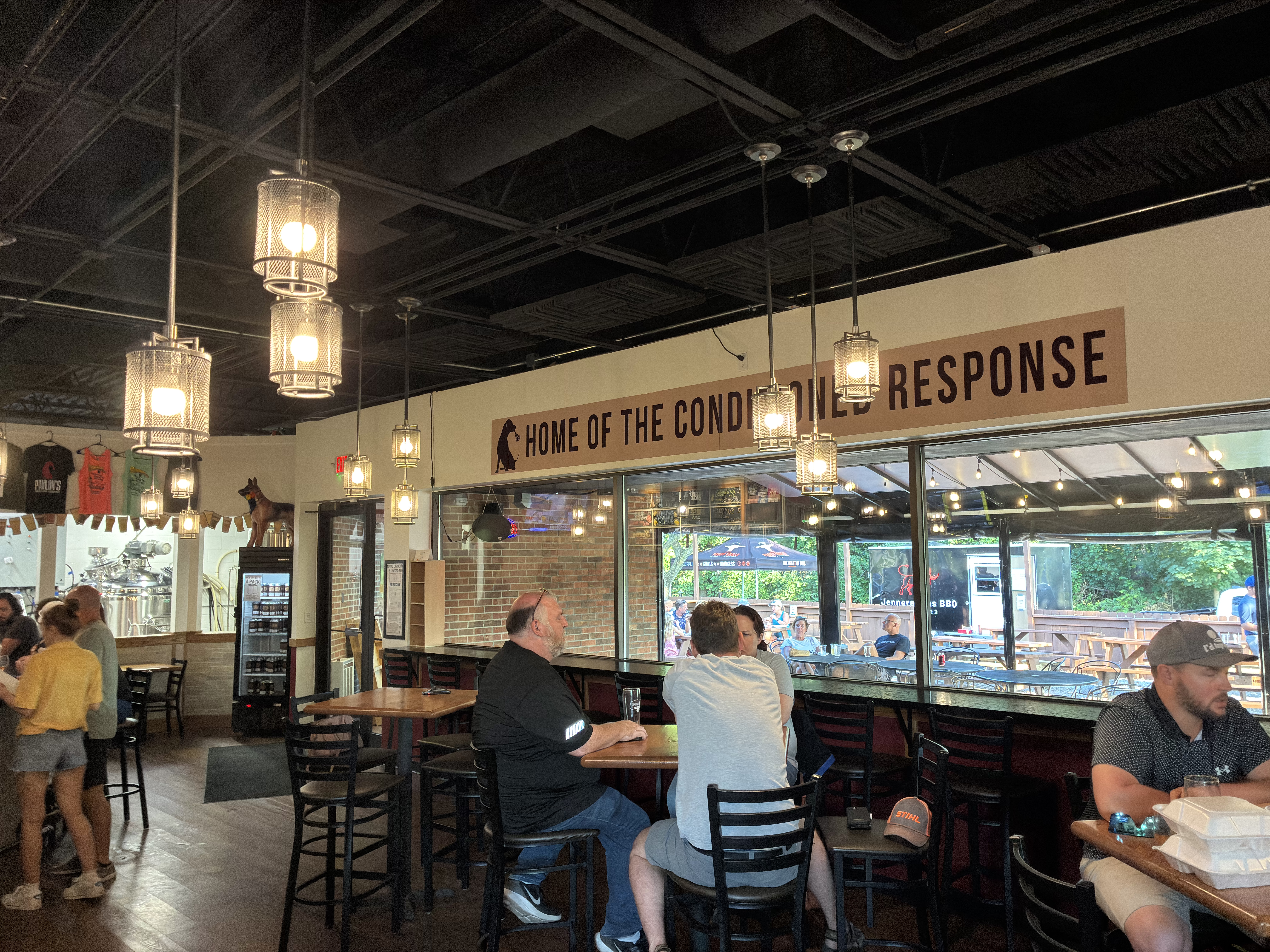
  • Pavlov’s Brewing Co., Temperance, MI
  • San Diego Tap Room, San Diego, CA
  • Seek Beer Co., San Diego, CA
  • Stone Brewing, San Diego, CA (Airport Location)
  • Vault Brewing Company, Yardley, PA
  • Woods Boss Brewing Company, Denver, CO

INTERNATIONAL (6)

  • Beer Academy Ethnograph, Yerevan, Armenia
  • Brovaria, Poznan, Poland
  • Pivovar Golem, Košice, Slovakia
  • Pivovar Hostinec, Košice, Slovakia
  • Steamworks Brewing Co., Vancouver, Canada
  • Yaletown Brewing Company, Vancouver, Canada
60cc Brewing, Toledo, OH
Beer Academy Ethnograph, Yerevan, Armenia
Bell’s Eccentric Cafe, Kalamazoo, MI
BJ’s Restaurant and Brewhouse, Toledo, OH
Blind Lady Ale House, San Diego, CA
Brovaria, Poznan, Poland
CLAG Brewing Co., Sandusky, OH
Dark Horse Brewing Company, Marshall, MI
Gordon Biersch Brewing Company, Romulus, MI (Airport Location)
Great Black Swamp Brewing Co., Toledo, OH
Harland Beer Co., San Diego, CA (Bay Park Location)
Hoptometry Brewing, Tiffin, OH
Inside The Five Brewing Co., Sylvania, OH
Inside The Five Brewing Co., Perrysburg, OH
Inside The Five Brewing Co., Toledo, OH
Jackie O’s Pub and Brewery, Athens, OH
Maumee Bay Brewing Co., Toledo, OH
New Holland Brewing Co., Battle Creek, MI
North Park Beer Co., San Diego, CA (North Park Location)
Old Dog Alehouse & Brewery, Delaware, OH
Patron Saints Brewery, Toledo, OH
Pavlov’s Brewing Co., Temperance, MI
Pivovar Golem, Košice, Slovakia
Pivovar Hostinec, Košice, Slovakia
Quenched & Tempered Brewing Co. Toledo, OH
Red Rock Brewery, Salt Lake City, UT (Airport Location)
San Diego Tap Room, San Diego, CA
Seek Beer Co., San Diego, CA
Steamworks Brewing Company, Vancouver, Canada
Stone Brewing, San Diego, California (Airport Location)
The Laird Arcade Brewery, Tiffin, OH
Vault Brewing Company, Yardley, PA
Woods Boss Brewing Company, Denver, CO
Yaletown Brewing Company, Vancouver, Canada
Voodoo Brewing Company, Toledo, OH

One Afternoon in Košice

Earlier this summer I spent five days in Košice, Slovakia. I was there as a guest of the Technical University of Košice (TUKE) participating in a summer institute for PhD students. The focus of the institute was identifying and discussing those factors that can make cities more resilient in the face of challenges such as climate change, global health pandemics, geo-political conflicts etc. This was my second visit to Kosice in as many years, having participated in the same event last year.

Returning to Košice gave me the opportunity to catch up with Peter Škripko who owns Pivovar Hostinec, one of two breweries in the city. Pivovar, incidentally, is the Slovak word for brewery. Last year, I had spent a wonderful afternoon with Peter cycling around Košice with stop-offs at some of his favorite places to drink beer. This year, Peter picked me up from hotel in his beautiful Porsche. The first stop was Ovečka KE.CY Kiosk and beer garden, located in the Čermeľská Valley just outside the city. Starting just north of the city, the valley stretches 16km into forested hills. The 150-seater beer garden is popular with families who want to escape the city easily, as well as hikers who want some fresh air and exercise. The valley has been a destination for Košice residents since the 19th century.

According to its website, “the attraction of the kiosk are special draft beers”. The special draft beers in this case are brewed by Pivovar Hostinec. Indeed, the only beer sold at Ovečka is from Hostinec. Ovečka, in fact, is one of only two places, apart from the brewery, that sells Hostinec’s beer. The reason is simple – quality control. Based on past experience Peter is concerned about bars and restaurants handling his beer in such a way as to ensure it tastes as it should. This is an industry-wide concern. Issues that craft breweries face when others serve their beer include improperly maintained draft systems (i.e. dirty beer lines), dirty glassware, warm storage etc. The more bars and restaurants that sell a brewery’s beer the harder it is to maintain quality control. According to Julia Herz, Executive Director of the American Homebrewers Association, when the integrity of a beer is compromised “it’s very difficult to enjoy a beer as the brewer intended“. Peter wants everyone to enjoy his beer as he intended it to be enjoyed.

Ovečka KE.CY Kiosk

After a beer at Ovečka, we headed to Peter’s apartment where we had a light snack and a beer while enjoying a panoramic view of Košice from the comfort of his patio. The beer we had was a collaboration between Hostinec and Sibeeria Brewery in Prague in the Czech Republic. Called, “We Are From Exit” it was a delicious Double New England IPA, with an ABV of 8.2%. An interesting feature of this beer is its label, which was designed using AI. I wonder how common using AI to design labels is in the craft brewing industry. And will it become increasingly common in the future?

A panoramic view of Košice from the patio of Peter’s apartment
The label on this collaboration beer between Pivovar Hostinec and Sibeeria Brewery was designed using AI.

Following a beer at Peter’s apartment we headed, by foot, into the center of Kosice. The remainder of the afternoon was spent visiting some of the city’s best drinking establishments. As we walked around the city center, I was impressed with how many people Peter knew. He is clearly a well-established and well-liked member of Košice culinary scene.

Enjoying a beer with Eric, a bartender at one of Peter’s favorite beer spots

One of the places we visited was the other craft brewery in Kosice, Pivovar Golem. This was my first visit to this brewery. Curious about the name of the brewery, I learned that a golem is an anthropomorphic creature in Jewish folklore. It is often made from clay or mud. Perhaps the most famous golem narrative was written by the revered Yiddish writer I. L. Peretz in 1890. The setting for Peretz’s short story is the city of Prague in what today is called the Czech Republic. In the story, a rabbi (Rabbi Loew) brings a golem to life by placing a magic word in its mouth. At first, the golem protects the Jewish ghetto. One day, however, it flies into a rage and causes all sorts of physical damage, including the smashing of buildings. To put an end to the destruction, Rabbi Loew removes the word from the golem’s mouth, and it dissolves into dust. Shaken by the turn of events, Rabbi Loew promises himself never to bring a golem to life again. Today, it is said that the dusty remains of that particular golem are to be found in a closed-off attic of the Old New Synagogue in Prague.

The entrance to Pivovar Golem
The interior of Pivovar Golem
Peter at Pivovar Golem, with a golem in the background

It wonderful to be in the city of Košice again and to have the opportunity to spend an afternoon and catch-up with Peter Škripko. As always, Peter was amazingly generous with his time and treated to a wonderful tour of some of his favorite drinking places in the city. Walking is always a wonderful way to see a city and doing that walk with a native makes it even better. So, thank you to Peter for a wonderful afternoon. I hope we get the opportunity to do it again.

Seeking Great Beer in San Diego

I was in San Diego last week giving a guest lecture to students in the Craft Beer and Urban Economies class at the University of California-San Diego. The course is taught by my friend and colleague, Julie Wartell. As part of the class, students get the opportunity to visit and tour a local brewery. I was fortunate enough that my trip to San Diego coincided with a visit the class made to Seek Beer Co.

Julie, myself, and about 25 students descended on Seek Brewery early on a Sunday afternoon. Established in 2022, the brewery is located in the city’s North Park neighborhood, described by some locals as “the best beer neighborhood in the nation,” Like most craft breweries, it is relatively small. According to data provided to the Brewers Association, Seek produced 411 barrels of beer in 2023. It does have capacity for growth, however.

Our group was met at the brewery by founder and owner, Dave Ohmer. As with any brewery tour I go on, what interests me the most is hearing the owner talk about their background, their passion for brewing, and the opportunities and challenges that they see for their brewery and the industry more broadly.

Dave grew up in Cincinnati, Ohio. His emotional ties to this marvelous Midwest city are still evident in the Bengals banner that has pride of place in his production space. A interesting feature of Dave’s journey to brewer and brewery owner is that he never home brewed. This is highly unusual in the brewing industry. Data show that approximately 90% of today’s commercial craft brewers started on their professional journey as home homebrewers. During college, where he studied music, Dave waited tables at Downtown Grill and Brewery in Knoxville, TN. One day he asked the owners if he could volunteer in the brewhouse. His volunteer position transitioned to a paid position and from scrubbing floors and cleaning kegs he worked his way up to full-time brewer. Additional positions at Saw Works Brewing in Knoxville and Whole Foods Brewing Co. and Urban South Brewery in Houston, TX allowed Dave to expand his knowledge base and hone his brewing skills.

With a Bengals bag in the background, Dave Ohmer tells us about the brewing process

Seek has a relatively small taproom. A sign on the wall indicates that the space, legally, play host to 43 people. There is, however, an outdoor space, share with a neighboring brewery. This is vital to Seek’s success as it allows the brewery to serve more customers from its taproom. Currently, the taproom is responsible for 70% of Seek’s sales. The other 30% is self-distributed to local bars and restaurants. Going forward, Dave would like to increase the percentage of his sales that come from the taproom. Simply put, the profit margins on a taproom keg are just so much more generous than one that is distributed. During our visit, Dave mentioned that there had been rumblings of the outdoor space being converted to half-a-dozen parking spaces – this would not be a good development from Seek’s perspective.

When I was there Seek had about a dozen different beers on offer, including a Vienna Lager, a Coffee Stout, a Fruited Sour, a West Coast IPA, and a Hazy IPA. One thing that I noticed about the beers available was that all but one (an Imperial Coffee Stout) had ABS of under 7%. I asked Dave about this, and he said that this simply reflected market demand. Higher ABV beers had not been selling fast enough. This preference for lower ABV beers (although many would consider 6.9% to be quite high; its relative guess) is consistent with a broad market shift towards lower alcohol beers that has been observed. As a beer drinker who prefers beer to be under 7% ABV, I appreciated the wide choice of such brews on offer at Seek.

While a relative newcome to the San Diego beer scene, Seek has made a big impact. At the 2025 San Diego Beer News Awards (SDBNA), Seek won in six categories (Best Customer Service, Best Hazy IPA, Best Imperial IPA, Best Pilsner, Best Collaboration Beer and the inaugural Best Alternative Beverage award). What struck me about this list of awards was that not only does Seek produce great beer, but they also provide fantastic customer service. Behind the bar at Seek when I visited was Taproom Manager, Tyler Hamman. Along with Beertender, Savanah Marshall, Hamman is key to the great service that Seek’s customer’s experience. This was not the first time Seek had won the Best Customer Service Award – they had previously done so in 2023.

As Dave Ohlmer builds his brewery’s brand, and hopefully its taproom sales, providing good customer service is critical. In a research paper published in 2023 in the journal Agricultural and Resource Economics Review, researchers from Cornell University examined the relationship between various taproom characteristics and customer satisfaction. They found that the two most important contributors to customer satisfaction were the taproom’s interior ambience and the friendliness and knowledge of servers. And, perhaps not surprisingly, customers who were more satisfied with their taproom experience tended to stay longer, buy more beer, and spend more money.

Seek is also a brewery that is very engaged with its community. I experienced this on a previous visit in 2024. On that trip, Julie took me to Seek on a Monday evening. This happened to coincide with the weekly meeting of the Seek Run Club. Every Monday at 6pm, a group of folks meet up and have an at-your-own-pace walk/jog/run around the North Park neighborhood, at the end ow which everyone meets back at Seek for a beer (or two) and an opportunity to socialize. This activity is an indicative of a larger trend of breweries becoming the focus of what is generally known as Leisure Time Physical Activity (LPTA). The LPTA can be yoga, running, cycling, or any other activity that involves some level of physical exertion. The Run Club has become such a part of the identity of the brewery that one of the beer’s produced by Seek is called “On a Monday” a Light Lager with an ABV of 4.2% and has been dubbed as the “official beer of the Seek Run Club”.

The Seek Run Club meets every Monday
Seek Beer Run Club members enjoy a post-run beer
“On a Monday” – the official beer of the Seek Run Club

Further Reading:

Li, Jie, Sara M. WagneR, Miguel I. Gomez, and Anna Katharine Mansfield. 2023. Customer satisfaction and sale performance in New York State brewery tasting rooms. Agricultural and Resource Economics Review, Volume 52, Pages 132–150.

Seaman, Alana N, Lindsey Schroeder, Laura Morris, Kayla Hines, and Michele Abee. 2024. “Ten bucks for yoga and a beer in a cool vibey spot”: Exploring motivations for LTPA at craft breweries. Leisure Studies.

Brewery Talk

As an academic who researches and writes about the brewing industry, I give a lot of presentations at academic conferences. The vast majority of these take place either in a hotel (common in North America) or on a university campus (common in Asia, Europe, and Latin America). Occasionally, however, I give a presentation about the brewing industry in a brewery. Last year was a good one in that respect. I gave four presentations in three different breweries – Quenched and Tempered Brewing Co. in Toledo, OH (two presentations), Hostinec Brewery in Košice, Slovakia, and Dargett Brewpub in Yerevan, Armenia.

Talking about the brewing industry while standing in a brewery has a number of advantages over giving a presentation in a non-brewery setting. For example, it is not uncommon for the fermentation tanks to be in full view, transforming what otherwise might be a fairly standard presentation into an experiential occasion. Also, there is always a member of the brewery staff (often the owner and/or master brewer) on hand to provide his/her insights on the industry, to tell the story of his/her brewery, and/or to lead the audience through a tasting of some of the brewery’s beers.

Those working in the craft brewing industry are amazingly passionate and generous individuals. They love to talk about the industry and to share their own personal journey from home brewer to the proud owner of a commercial brewery. Their passion is most apparent when they are leading the audience through a tasting of their beer. About a week before Christmas, I gave a presentation on the history of Christmas Ales at Quenched and Tempered (Q&T) Brewing Co. in my home city, Toledo. After my presentation, audience members were given a sample of the beer Q&T had brewed for the holiday season – a Belgian Quad, which weighed in at an impressive 11.2% ABV. As the samples were being distributed and enjoyed, brewery owner and brewmaster, Alex Drozdowicz, shared his inspiration for the brew and talked about the brewing process and the beer’s ingredients, which included cinnamon, clove, cardamom, cranberry, and orange peel. There is no question that my presentation was enhanced by the brewery setting , the opportunity to sample the brewery’s beer, and to hear Alex share his passion and knowledge.

Quenched and Tempered Winter Holiday Ale (Photo credit: Quenched and Tempered Brewing Co.)

In 2024, I also gave presentations at Hostinec Brewery in Košice, Slovakia, and Dargett Brewpub in Yerevan, Armenia. Both of these presentations were given as part of conferences I was attending. The idea was to combine an evening of local beer and food with a short educational program about some aspect of the brewing industry.

At Hostinec Brewery, I spoke about the origins of the craft beer revolution, after which brewery owner Peter Škripko talked about the history of the brewery and led attendees through a tasting of four of his beers. After the tasting, we were given a tour of Hostinec’s production space and the opportunity to sample more beer straight from the fermentation tanks.

Talking about the evolution of the craft beer movement at Hostinec Brewery in Košice, Slovakia
Peter Škripko led our group through a tasting of some of his brewery’s beers
Owner Peter Škripko gave conference attendees a tour of Hostinec’s production space

At Dargett Brewpub in Yerevan, Armenia I gave a short presentation on the globalization and fragmentation trends that had been sweeping through and changing the face of the global brewing industry since the mid-1980s. After my presentation, Inna Khostikyan, Executive Director of Dargett Brewery spoke about Dargett and its emergence as a major player in the Armenian craft beer market. Inna fielded a number of questions from conference attendees, providing them with a unique insider’s view of the craft brewing industry in Armenia.

Talking about the popularity of craft beer at Dargett Brewpub in Yerevan, Armenia
Inna Khostikyan, Executive Director of Dargett Brewpub tells the audience about Dargett Brewery 

Craft breweries are examples of what Conrad Kickert of the School of Architecture and Planning at the State University of New York in Buffalo refers to as “maker ecosystems”, which are characterized by “shared production, education, distribution and sales facilities”. In other words, craft breweries are so much more than just places where beer is produced and where people go to drink beer. They are often multi-functonal community spaces where everything from yoga classes to book clubs, to educational programing takes place. This makes them invaluable assets to the communities within which they are embedded

Next month, I’ll be back at Quenched and Tempered Brewing Co., here in Toledo where I will be talking about St. Patrick and the history of Irish brewing. The brewmaster, Alex, will have his Irish Red Ale on tap and I am sure that folks will enjoy learning about the brewing process and the malts and hops that give it its unique aroma and flavor.

2024 Year in Review

Between 2017 and 2021, at the end of each year, I posted a blog entry documenting all the breweries I had visited during the calendar year. Included was one photograph from each brewery. In 2022, I did not post such an entry. I can’t quite remember why this was the case. However, I also failed to make an end-of- year posting in 2023. Anyway, 2024 is almost over and I thought I’d get back into the habit of documenting the breweries I visited.

During 2024, I visited a total of forty-five breweries. Before going any further, I should define what I am counting as a brewery. Any establishment owned by a brewery, whether beer is brewed on-site or not, is included in my list. For example, Inside The Five Brewing Company has three locations in northwest Ohio. At only one of those locations is beer brewed. However, all three locations are included in the list of breweries I visited in 2024.

Of the forty-five breweries I visited in 2024, eighteen were in my home state of Ohio, seventeen were located elsewhere in the United States, and ten were outside of the United States. Of the seventeen breweries I visited elsewhere in the United States, four were in the neighboring state of Michigan. Toledo, where I live, is located just south of the Ohio/Michigan border, so visits to Michigan breweries are fairly routine. Trips to California, Indiana, Nevada, and Pennsylvania afforded me the opportunity to visit breweries in those states. In terms of breweries outside of the United States, two trips to Canada, as well as trips to Armenia and Slovakia, meant that I visited more non-US breweries than I normally do.

Of the forty-five breweries I visited, sixteen were repeat visits. This meant there were twenty-nine breweries that I visited for the first time (indicated in bold font in the list below).

I hope you enjoy the photographs below. I wish every one a Happy New Year and hope that 2025 is a wonderful year for you.

OHIO (18)

  • 60CC Brewing, Toledo, OH
    Arlyn’s Good Beer, Bowling Green, OH
  • Brewing Green, Bowling Green, OH
  • Earnest Brew Works, Toledo, OH (Downtown Location)
  • Earnest Brew Works, Toledo, OH (Westgate Location)
  • Great Lakes Brewing Co., Cleveland, OH
  • HEAVY Beer Co., Toledo, OH
  • Inside the Five Brewing Co., Perrysburg, OH
  • Inside the Five Brewing Co., Sylvania, OH
  • Inside the Five Brewing Co., Toledo, OH
  • Juniper Brewing Co., Bowling Green, OH
  • Maumee Bay Brewing Company, Toledo, OH
  • Oncore Brewing, Swanton, OH
  • Patron Saints Brewery, Toledo, OH
  • Quenched and Tempered Brewing Company, Toledo, OH
  • Twin Oast Brewing, Port Clinton, OH
  • Upside Brewing, Sylvania, OH
  • Wild Side Brewing Company, Toledo, OH

REST OF UNITED STATES (17)

  • Ballast Point Brewing Company, San Diego, CA (Little Italy Location)
  • Blake’s Brewing Company, Almont, MI
  • Blake’s Brewing Company, Armada, MI
  • Brewery Saint X, New Orleans, LA
  • Chicago Brewing Company, Las Vegas, NV
  • Crescent City Brewhouse, New Orleans, LA
  • Evil Czech Brewery and Public House, Mishakawa, IN
  • GOAL. Brewing, San Diego, CA
  • Gordon Biersch Brewery, Romulus, MI (Airport Location)
  • Iron Hill Brewery & Restaurant , Phoenixville, PA
  • Jolly Pumpkin, Romulus, MI (Airport Location)
    Red Hook Brewery, Salt Lake City, UT (Airport Location)
  • Triple 7 Restaurant and Brewery, Las Vegas, NV
  • Stone Brewing, San Diego, CA (Airport Location)
  • Sun King Brewery, Mishakawa, IN
    TapRoom Beer Co., San Diego, CA (Pacific Beach Location)
  • Seek Beer Co., San Diego, CA

INTERNATIONAL (10)

  • 379 Torch & Brew, Yerevan, Armenia
  • Banded Goose Brewing Company, Kingsville, ON, Canada
  • Dargett Brewpub, Yerevan, Armenia
  • Fairweather Brewing Company, Hamilton, ON
  • Grain & Grit Beer Co., Hamilton, ON, Canada
  • Hostinec Brewery, Košice, Slovakia
  • Shawn & Ed Brewing Company, Hamilton, ON, Canada
  • The Beerded Dog, Harrow, ON, Canada
  • The Grove Brewing Company, Kinsgville, ON, Canada
  • The George Hamilton Restaurant & Brewery, Hamilton, ON, Canada
379 Torch & Brew, Yerevan, Armenia
60CC Brewing, Toledo, OH
Arlyn’s Good Beer, Bowling Green, OH
Ballast Point Brewing Company, San Diego, CA (Little Italy Location)
Banded Goose Brewing Company, Kingsville, ON
Blake’s Brewing Co., Almont, MI
Blake’s Brewing Co., Armada, MI
Brewery Saint X, New Orleans, LA
Brewing Green, Bowling Green, OH
Chicago Brewing Company, Las Vegas, NV
Crescent City Brewhouse, New Orleans, LA
Dargett Brewpub, Yerevan, Armenia
Earnest Brew Works, Toledo, OH (Downtown Location)
Earnest Brew Works, Toledo, OH (Westgate Location)
Evil Czech Brewery and Public House, Mishakawa, IN
Fairweather Brewing Company, Hamilton, ON, Canada
GOAL. Brewing, San Diego, CA
Gordon Biersch Brewimg, Romulus, MI (Airport Location)
Grain & Grit Beer Co., Hamilton, ON, Canada
Great Lakes Brewing Co., Cleveland, OH
Hosintec Brewery, Košice, Slovakia
Inside The Five Brewing Co., Perrysburg OH
Inside The Five Brewing, Sylvania, OH
Inside The Five Brewing Co., Toledo, OH
Iron Hill Brewery & Restaurant, Phoenixville, PA
Jolly Pumpkin, Romulus, MI (Airport Location))
Juniper Brewing Co., Bowling Green, OH
Maumee Bay Brewing Co., Toledo, OH
Oncore Brewing, Swanton, OH
Patron Saints Brewery, Toledo, OH
Quenched and Tempered Brewing Company,Toledo, OH
Red Rock Brewery, Salt Lake City, UT (Airport Location)
Seek Beer Co., San Diego, CA
Shawn & Ed Brewing Company, Hamilton, ON, Canada
Stone Brewing, San Diego, CA (Airport Location)
Sun King Brewery, Mishakawa, IN
TapRoom Beer Co., San Diego, CA (Pacific Beach Location)
The Beerded Dog Brewing Co., Harrow, ON
The Grove Brewing Company, Kingsville, ON, Canada
Triple 7 Restaurant and Brewery, Las Vegas, NV
Twin Oast Brewing, Port Clinton, OH
The George Hamilton Restaurant & Brewery, Hamilton, ON, Canada
Upside Brewing, Sylvania, OH
Wild Side Brewing Company, Toledo, OH

Pivovar Hostinec

Earlier this year, I spent a week in the city of Košice in Slovakia. I was there participating in a week-long Summer Institute at the Technical University of Košice. The participants in the Summer Institute were faculty from nine countries and doctoral students from five countries. The event was described as a week-long bootcamp in which participants would explore, discuss, and debate “the X-factor of a city” – the X-factor being those characteristics and features of a city that contribute to it being high performing and making it a wonderful place to live and work.

Among other responsibilities, my participation in the event included giving an hour-long presentation on a topic of relevance to the bootcamp’s theme. My particular presentation focused on the role and importance of Third Places in the modern city. For those of you unfamiliar with the concept of Third Places, they are, to quote the urban sociologist Ray Oldenburg, “nothing more than informal public gathering places”. Much of my own research on the craft brewing industry has examined how craft breweries function as neighborhood Third Places in towns and cities across America. You can read some of my thoughts on craft breweries as Third Places here, here, and here. While my presentation included some discussion of the role of American craft breweries and British community pubs as Third Places, much of it focused on the concept of Third Places more broadly.

Getting ready to talk about Third Places at the Technical University of Košice

If you are unfamiliar with the city of Košice, it is the second largest city in the country and the largest city (population ~240,000) in eastern Slovakia. Dating back to the 13th century, the city has a long and fascinating history. At various times during its history, it was part of the Kingdom of Hungary, the Principality of Transylvania, the Austro-Hungarian Empire, and Czechoslovakia. Since the break-up of Czechoslovakia in 1993, it has been part of the Slovak Republic.

On the second to last evening of the bootcamp we had a farewell gathering. And guess what – this was held in a brewery. Pivovar Hostinec (Hostinec Brewery) was established in 2015 by Peter Škripko. It is housed in a building that dates to the second half of the 15th century. Originally a private residence, it was purchased by the city of Košice in 1569 and run as an inn. In 1617, a section of the building was leased and converted into a printing house; the first printing house in Kosice. Records indicate that part of the building was used as a brewery (the first in Košice) in 1604. The building was also the venue for the wedding festivities of Gabriel Bethlen, the Prince of Transylvania, and Catherine of Brandenburg in 1626. The marriage established an alliance between the Protestant Prince of Transylvania and the Protestant powers of Denmark and Sweden. This is certainly a building with a long and rich history. But that’s enough history. Let’s talk about beer.

Knowing my interest in craft brewing, the conference organizers asked me if I would be willing to collaborate with the brewery owner, Peter Škripko, and host a short but educational and fun presentation to kick-off the evening’s proceedings. Peter and I had a Zoom call and devised a plan of action. I would give a short presentation on the history of the craft brewing movement, after which he would provide an overview of the history of the brewery. Following that, Peter would lead the attendees through a tasting of four of the brewery’s beers.

Talking about the origins of the craft brewing movement at Hostinec Brewery
Peter led our group through a tasting of some of his brewery’s beers

Like many European craft breweries, Pivovar Hostinec, has a relatively small number of different beers on tap at any given time. Unlike many American craft breweries, which might have over a dozen different beers on tap, Pivovar Hostinec usually has six. The formal beer tasting was followed by a tour (and more tasting) of one of the brewery’s cellars where the fermentation tanks are housed. Not surprisingly, the evening was a roaring success, much of which was due to Peter’s vibrant and generous personality (and copious amounts of beer).

The evening finished with a tour of the cellars where Hostinec’s beer is brewed
Our group enjoyed the opportunity to tour Hostinec’s production space while sampling more beers

As I noted at the beginning of this blog entry, the aim of the week was to identify those characteristics and features of a city that contribute to it being high performing and making it a wonderful place to live and work. As the evening wound down, there were few of us who did not appreciate the role that Peter Škripko and Pivovar Hostinec play in enhancing the quality of life in the city of Košice.

The Generosity of Peter Škripko

Craft brewers are incredibly generous people. This generosity is manifest in a myriad of ways. As an example, take their efforts in support of charitable initiatives. While the data are rather dated, in 2016, American craft breweries donated an astonishing $73.4 million to charities. Many of these dollars benefited organizations in their own communities and, by extension, local residents. In 2019, 95 craft breweries in the state of Minnesota who responded to a survey, reported contributing $874,310 to 3,000 community and charitable organizations.

In the 10+ years I have been studying the craft brewing industry I have also found craft brewers very generous of their time when I have asked them for an interview or tour of their brewery. This does not surprise me. Craft brewers are passionate about their profession and are very happy to make the time to share that passion with you.

Recently I experienced an unprecedented example of craft brewer generosity. I was in the city of Košice in Slovakia to participate in a Summer Institute at the Technical University of Košice (TUKE). Prior to my visit my friend and colleague, Oto Hudec (who is on the faculty at TUKE) had connected me with Peter Škripko, the owner of Pivovar Hostinec, one of two breweries in the city. Peter offered to give me a tour of both his brewery and the city, including a visit to some of his favorite craft beer bars.

Peter and I had arranged to meet after lunch on a Wednesday afternoon. During lunch, Oto got a telephone call from Peter, asking if I would be comfortable touring the city by bike rather than by foot. This would allow Peter to provide me with a geographically more expansive tour of the city. When Oto asked me about the possibility of touring by bike, I must admit that I hesitated. You see, I had not ridden a bicycle since I was teenager, over 40 years ago. Despite my hesitation, I agreed to undertake the tour by bike. After all, riding a bike must be just like “riding a bike” – if I had done it before, I could surely do it again.

Peter picked me up in his car outside the restaurant where I had lunch and drove me to his brewery. Her fixed me up with one of the brewery’s bikes and after some adjustment to the saddle we were ready to go.

Bike tour of Košice with Peter Škripko
My first time riding a bike in over 40 years

As with many European cities I have visited, Košice is bike-friendly, with ample bike paths. Peter proved to be a fantastic tour guide. This was the city of his birth, and he knew a great deal about its history. He also knew the best places to get a craft beer, and we had numerous refreshment stops during our 8km+ ride.

We made several stops for beer during our bike tour of Košice

Our penultimate stop before arriving back at the brewery was Camelot Restaurant, also owned by Peter. At Camelot, under Peter’s watchful eye, I had the opportunity at trying my hand at pouring (tapping) some Pilsner Urquell. Pilsner Urquell, of course, is famous as being the original pilsner beer, having been first brewed by brewmaster Josef Groll in 1842 in the city of  Plzeň in the Czech Republic.

Peter knows a thing or two about Pilsner Urquell. In 2011, he won the national competition to become Slovakia’s Pilsner Urquell Master Bartender. The competition tested not only Peter’s ability to pour and serve a glass of Pilsner Urquell, but also his ability to communicate effectively with customers, and his knowledge of the history of the famous beer. Winning the national competition made Peter eligible to represent Slovakia in the international bartender competition, where he placed an impressive third.

In 2011, Peter became Slovakia’s Pilsner Urquell Master Bartender. This poster in Camelot highlights this achievement

There are three ways in which Pilsner Urquell can be served – Hladinka, Šnyt, and Mlíko. The standard pour is the Hladinka, which has “three fingers” of foam atop the lager. The Šnyt (pronounced ‘shnit’), is two parts beer, three parts foam and one part empty space at the top of the glass. The Mlíko is a glass of foam, with just a small amount of beer at the bottom. Each pour type is created to pair with different foods. The Hladinka pairs well with rich foods like duck, theŠnyt with hearty food like goulash or a burger, and the Mlíko with dessert.

The three ways in which Pilsner Urquell can be served – Hladinka (left), Šnyt (center), and Mlíko (right). Photo source: PilsnerUrquell.com.

Peter and his bartenders demonstrated the different pours to me and then gave me the opportunity to try my hand. You can judge how successful I was by the video posted here

Enjoying the fruits of my labor with two of Camelot’s wonderful bar staff
Enjoying another Pilsner Urquell with Peter

The following day I met up with Peter again, this time at his brewery. We were going on another tour. This time it was on foot, however, and involved going no further than the cellars of the brewery where Hostinec’s fermentation tanks are housed. Once there, I spent a glorious couple of hours with Peter talking about our common passion for the liquid nectar, while sampling at least a dozen different beers straight from the fermentation tanks.

The day after our bike tour, Peter gave me a tour (and a taste) of his production space
One of the dozen or so beers I sampled while touring Peter’s production space

As I said in my introduction to this blog entry, craft brewers are generally very generous individuals. But Peter Škripko took that generosity to a whole new level when he spent a significant chunk of time with me on my visit to Košice. Thank you, Peter, for being such a generous host.

Selling Your Home? Don’t Forget To Mention That Brewery

In 2023, according the National Association of Realtors, the number of existing homes that were sold was just over four million, with an average sales price of $389,300. One of the steps in preparing your home for sale is to write a real estate description in which you outline the key features of your home and the neighborhood in which it is located. Writing for the website Orchard.com, Allaire Conte notes, “A good, effective real estate listing description can attract the right buyers and generate interest in the property. It only makes sense that a poor description can do the opposite, scaring away potential buyers and leaving the property sitting on the market with no offers”. According to Dorothy O’Donnell and Kelsey Morrison, who write for the website Homelight.com, “The listing description is your chance to emphasize the best aspects of both your home and the surrounding area, whether you have access to quality schools or are walking distance from the historic district with boutiques and microbreweries. Access to breweries? Do people really mention those as a neighborhood amenity when listing their home for sale? Apparently they do, indicating that mentioning them can make a home more attractive to potential buyers.

That people would mention proximity to breweries in their home listings does not surprise me. I have been studying the craft brewing industry for over ten years now; particularly the impact of breweries on neighborhoods and communities. As a result of this research, and the research of others, I have arrived at the conclusion that craft breweries are neighborhood assets and that living close to one is a good thing. This is primarily because craft breweries serve as neighborhood Third Places, where friends and family can gather for a pint of locally brewed IPA while enjoying each other’s company. Many craft breweries are also child and dog friendly, making them places where young families are welcome.

Many breweries, such as Birdson Brewing in Charlotte, NC are child and dog friendly

Some of the research I have conducted has focused on the city of Charlotte, NC. Charlotte has a vibrant craft brewing, with over eighty breweries dotted across the metropolitan area. Two neighborhoods which have attracted a disproportionate number of craft breweries are the post-industrial districts of South End (south-west of downtown) and NoDa (north-east of downtown). My research on Charlotte has been carried out in collaboration with my colleague Isabelle Nilsson, a faculty member at the University of North Carolina in Charlotte. In a paper I published with Isabelle in 2019, we were able to isolate the impact of being in close proximity to a craft brewery on residential real estate valued. In that research, we determined that single-family homes and condominiums within a half mile of a craft brewery enjoyed an increase in value of 9.2% and 3.2% respectively, as a result of this proximity. This suggests that many homeowners appreciate being within walking distance of a craft brewery.

In my most recent research with Isabelle, we compared 1,088 home listings that mentioned breweries with the same number of randomly selected home listings that did not mention breweries. As with our previous research, all the homes were in Charlotte, NC. An example of a home listing included in our study is shown below.

When location is key, you can’t get much better than this! 5 minutes from both NoDa & Plaza Midwood shopping, restaurants, and breweries. This 1920’s bungalow is full of charm & nestled in the Villa Heights community. Original hardwoods throughout portions of the home. Claw foot tub in the renovated bathroom. Fenced in back yard with mature trees. Smart features throughout the home include Ecobee thermostat & Alexa controlled lights/switches. Several projects in the home are unfinished & some updates are still needed, but with some TLC, you could have the cutest house on the block. Given the recent sales in the neighborhood, this would also be perfect for an investor looking to completely renovate for a flip. Home is being sold as is with no repairs to be made. HVAC is a 2021 unit & under warranty.”

According to a 2019 report by the National Association of Realtors, 93% of recent homebuyers found online websites as the most useful source of information about prospective homes. Of buyers who used the internet while searching for a home, 85% found detailed information about properties for sale very useful. This suggests that having a well-written, accurate, and appealing home listing is important in attracting potential buyers. The website Homes.com includes walkability and proximity to amenities (parks, gyms, restaurants etc.) as two of a number of neighborhood factors to consider when purchasing a home.

Proximity to Charlotte’s NoDa neighborhood, home of Heist Brewery, is mentioned as a neighborhood amenity in some home listings

In our most recent research, Isabelle and I were particularly interested in identifying the types of neighborhood in which craft breweries were being listed as a neighborhood amenity by home sellers. Our findings showed that homes mentioning breweries were generally higher priced and sold more quickly than the average home in the Charlotte metropolitan area. We also discovered that, in home listings, breweries were commonly mentioned in conjunction with other neighborhood amenities such as restaurants, coffee shops, and parks. This suggests that craft breweries tend to be located in amenity-rich neighborhoods and are being mentioned as part of a broader package of amenities. The term ‘walkable’ is also frequently mentioned in listings mentioning breweries. This suggests that breweries tend to be in walkable neighborhoods which, in all likelihood, have a high Walk Score. Indeed, the NoDa neighborhood has a Walk Score of 70, making it a “very walkable” neighborhood, where “most errands can be accomplished on foot”. Another word often mentioned is ‘local’. This may suggest geographic proximity and/or locally-owned establishments, such as breweries, book stores, coffee shops etc. A critical feature of Third Places is their accessibility. As noted by Ray Oldenburg, “Third places work . . . when they are local; and they work best when within walking distance of the people they serve”.

In addition to describing the neighborhood, home listings describe the house itself. In our study, words mentioned in the same listings where breweries were mentioned include ‘historic’, ‘bungalow’, ‘renovated’, and ‘original’, with the latter referring to a home’s features. Both South End and NoDa are historic neighborhoods in Charlotte, so these descriptors make sense. In the early 20th, NoDa was home to a number of textile mills and bungalow-style homes that housed the mills’ workers. The aforementioned Heist Brewery is housed in a former textile mill.

An old mill worker’s home in Charlotte’s NoDa neighborhood. This home is visible from Heist Brewery

The language used to describe the randomly selected sample of home listings that do not mention breweries are quite different. Words such as ‘acres’ (indicating large lots), ‘schools’, and ‘culdesac’, ‘bonus room’, ‘formal dining’, and ‘family room’ describe homes that are indicative of a more suburban setting. In these listings, more emphasis appears to be placed upon the feature of the home rather than the characteristics of the neighborhood.

The research conducted by Isabelle, and I added support to the idea that craft breweries are viewed by both home sellers and real estate agents as neighborhood amenities. Otherwise, why mention them? So, next time you go to sell your home, make sure you mention that brewery just down the street from you.

Further Reading:

Nilsson, Isabelle and Neil Reid. 2019. The value of a craft brewery: On the relationship between craft breweries and property valuesGrowth and Change, Volume 50, Issue 2, pp. 689-704.

Nilsson, Isabelle and Neil Reid. 2024. Craft breweries as a neighborhood amenity: Evidence from residential real estate listings. Urban Geography, Volume

Inside The Five and The Experience Economy

I am not a football fan (the American variety that is), but I do know that the phrase “inside the five” refers to the zone between the five-yard line and the goal. It is also the name of a brewery (with three locations) in northwest Ohio. Inside the Five Brewing Co. was established in 2018, with the first location opening in Sylvania, OH. Two of the brewery’s owners, Chris Morris and Brandon Fields, were at Michigan State University together – the former was an offensive linesman and the latter a punter on Spartans football team. Both would go on to play in the NFL – Chris with the Oakland Raiders and Brandon with the Miami Dolphins. Such was their desire to make craft beer more accessible to more people in northwest Ohio, they opened a second and third location in Perrysburg, OH in 2020 and Toledo, OH in 2023. After its opening, all beer production was consolidated at their Toledo facility. In 2024, they opened a taproom at the Toledo facility.

On Father’s Day weekend, I visited all three of Inside the Five’s (ITF) within the space of three days. While it had not been my intention to do so at the start of the weekend, circumstances transpired that I ended up enjoying beer at all three venues. On the Thursday evening, I got a text from a friend asking for suggestions as to where we could meet the next afternoon to watch the opening game of the European Soccer Championships between Germany and Scotland. I suggested a local sports bar, but Glynn made the case for ITF in Sylvania. So that is where we met, and while my team, Scotland, were on the wrong end of a 5-1 drubbing, I at least was able to watch it while enjoying some excellent local beer.

Sunday was Father’s Day of course. My wife had already suggested ITF in Perrysburg for a Father’s Day dinner. She chose it because it was a brewery taproom (and she knows I like breweries) and because of its location near her stepmother’s apartment. Her stepmother had recently undergone a second hip replacement surgery, so a dinner venue nearby seemed like a good idea. So, I knew that I was going there.

What I did not know, however, is that my wife had made plans (with my youngest daughter and her boyfriend) to take me to ITF in Toledo in the afternoon of Father’s Day. In many respects, this is the most impressive of the three ITF locations. As I noted above, all of ITF’s production occurs there in a beautiful purpose-built production facility/taproom. This location is named The Fieldhouse, a nod to its proximity to the University of Toledo

What really impresses me about this location, however, is the way that they have developed and utilize their sizeable outside space which sits at the back of the brewery. When we arrived just after 1:00pm a farmer’s market (including craft vendors) was in full swing. This occurs every Sunday during the June – September from 11am-3pm. The fact that the number of vendors was relatively small probably reflects the fact that the market is in its infancy (it had only been going for a few weeks). I am sure that it will grow as the summer progresses.

The newly established Farmer’s Market at Toledo’s Inside The Five Brewery (Photo taken by Neil Reid)
The newly established Farmer’s Market at Toledo’s Inside The Five Brewery (Source: Inside the Five’s Facebook Page)

While ITF’s other two locations are more oriented towards adults, its Toledo location is clearly designed to attract families, including those with young children. While I was there, I saw a number of families sitting on the brewery’s outdoor patio and children playing in the purpose-built play area. For those who want to be more active while enjoying one of ITF’s excellent beers, there are a number of outdoor yard games available such as cornhole, for customers to enjoy. If the weather is not conducive to being outside a nice selection of board games are available. The outdoor space also includes a firepit, where folks can sit down and enjoy a beer and perhaps something to eat from one of the rotating food trucks when the weather is cooler.

Toledo’s Inside The Five Brewery offers a number of experiences for its patrons (Photo taken by Neil Reid)
One of the rotating food trucks that sets up at Toledo’s Inside The Five Brewery (Photo taken by Neil Reid)
Fire Pit at Toledo’s Inside The Five Brewery (Source: Inside the Five’s Facebook Page)
Games available for customers to play (Photo taken by Neil Reid)

ITF’s Toledo location is part of two larger trends that have been manifest in the American craft brewing scene for a number of years. These are a desire to be a different kind of drinking space, where children are welcome and where there is more do than just drink beer.

As noted in a 2018 report published by the University of New Hampshire Cooperative Extension, “while breweries have a reputation for attracting young people, . . . they appeal to families as well. They provide an atmosphere that is comfortable for parents and their children to eat and enjoy social time with others”. This is exactly what is happening at ITF’s Toledo location.

ITF has also positioned its Toledo brewery to be part of what is termed the “experience economy”. According to Bart Watson, Chief Economist of the Brewers Association, experiential drinking, which he defines as “not just going to drink” but “going to do something… and drink”, is on the rise. And, according to Nielsen, Craft breweries are proving very adept providing “new and creative experiences for craft drinkers to engage with their favorite brews

The term “experience economy” is an interesting one. It was coined, as far as I can tell, by B. Joseph Pine II and James H. Gilmore in a paper published in the Harvard Business Review in 1988. There are ample data to show that people are increasingly spending more of their disposable income on experiences rather than things. This is particularly the case for the millennial cohort (the demographic frequently cited as the driving force behind craft beer’s popularity). Part of the reason why this might be the case is that, compared with things, purchasing experiences brings people more enduring happiness. Indeed, in a paper published in the Journal of Consumer Psychology, Ellizabeth Dunn and her co-authors suggest that to enhance their level of happiness, “consumers should buy more experiences and fewer material goods”. This is especially true of individuals with higher levels of disposable income (e.g., craft beer drinkers).

But why should purchasing experiences rather than things make people happier? In a paper published in Advances in Experimental Social Psychology in 2015, Thomas Gilovich and Amit Kumar suggest several reasons. These include the fact that experiences are often shared with other people, are less susceptible to unfavorable and unpleasant comparisons, and are less likely to invoke feelings of regret.

So, breweries that provide their patrons opportunities to engage in experiential drinking are in sync with a large portion of their customer base. The experiences offered by breweries do not need to be sophisticated or cost a lot of money to provide. Sitting round a fire pit with friends or playing a game of corn hole are often sufficient.

Inside the Five’s Toledo location is an excellent addition to its west Toledo neighborhood. The owners have taken a piece of undeveloped land and turned into an oasis where families and friends can go and have a beer and enjoy the amenities on offer. When I was there on Father’s Day, I noticed that there were still a couple parts of their property that remained undeveloped. I’ll be interested to see what they decide to do with these spaces.

Further Reading:

Dunn, Elizabeth W., Daniel T. Gilbert, and Timothy D. Wilson. 2011. If money doesn’t make you happy, then you probably aren’t spending it right. Journal of Consumer Psychology, Volume 21, Issue 2, Pages 115-125.

Gilovich, Thomas and Amit Kumar. 2015. We’ll always have Paris: The hedonic payoff from experiential and material investments. Advances in Experimental Social Psychology, Volume 51, Pages 147-187.

Pine, B. Joseph II and James H. Gilmore. 1998. Welcome to the experience economy. Harvard Business Review, Volume 76, Issue 4, Pages 97-105.