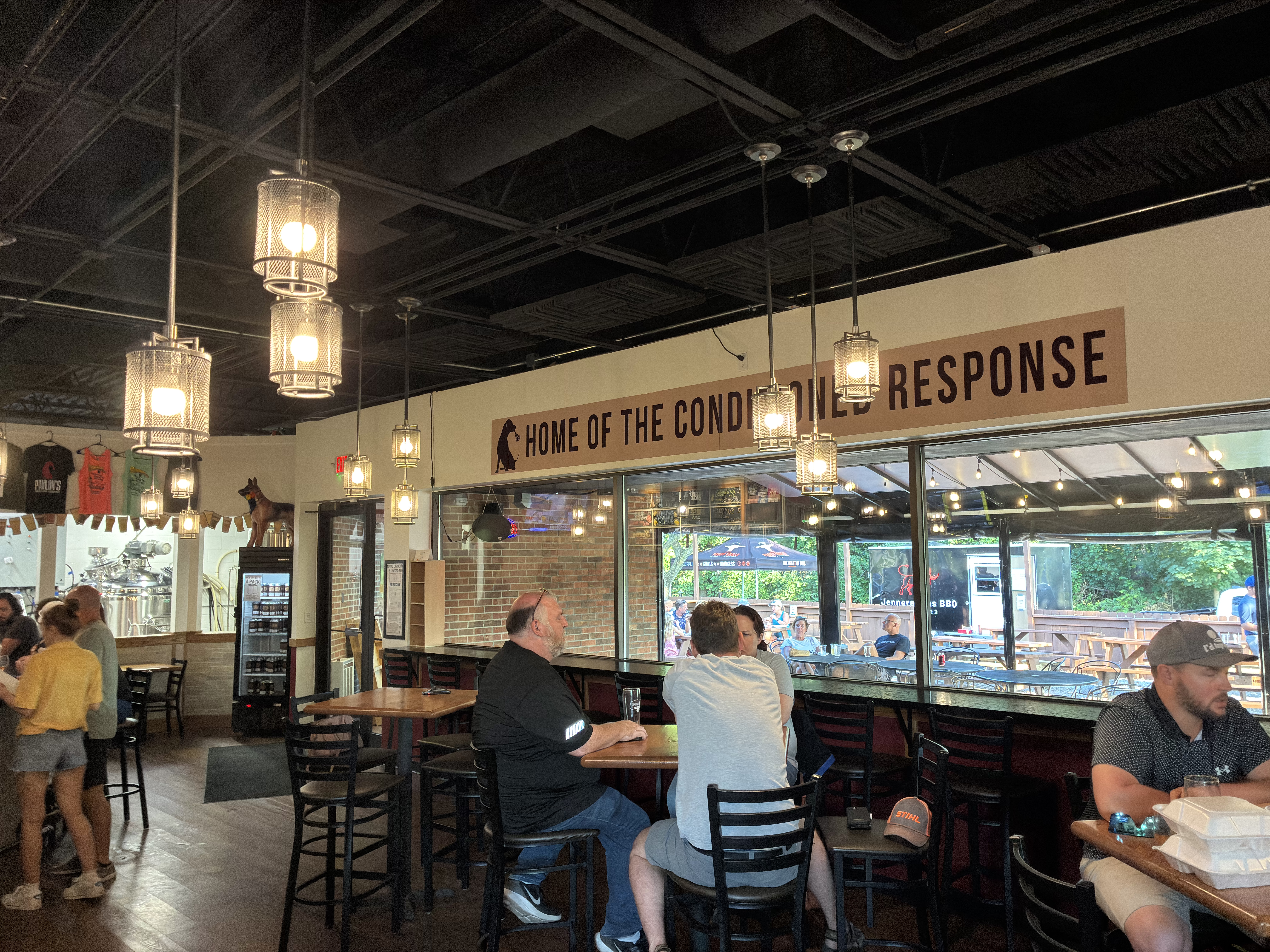
It is a tradition that my last blog entry of the year reflect upon the previous twelve months with a photo gallery of the breweries I visited during that period. In 2026, I visited a total of 35 breweries- 15in my home state of Ohio, 14 in other states, and 6 outside of the United States. The 14 breweries I visited in other states were located in California, Colorado, Michigan, Pennsylvania, and Utah, while those outside of the United States were in Armenia, Canada, Poland, and Slovakia. Of the 34 breweries 21 were ones I had visited before and 14 were first time visits (indicated in bold in the list below).
As per tradition, following the list below, I have included one photograph from each of the breweries I visited. Enjoy.
OHIO (15)
60cc Brewing, Toledo, OH
BJ’s Restaurant & Brewhouse, Toledo, OH
CLAG Brewing Co. Sandusky, OH
Great Black Swamp Brewing Co., Toledo, OH
Hoptometry Brewing, Tiffin, OH
Inside the Five Brewing Company, Sylvania, OH
Inside The Five Brewing Co., Toledo, OH
Inside the Five Brewing Co., Perrysburg, OH
Jackie O’s Pub and Brewery, Athens, OH
Maumee Bay Brewing Co., Toledo, OH
Old Dog Alehouse & Brewery, Delaware, OH
Patron Saints Brewery, Toledo, OH
Quenched & Tempered Brewing Co. Toledo, OH
The Laird Arcade Brewery, Tiffin, OH
Voodoo Brewing Company, Toledo OH
REST OF UNITED STATES (14)
Bell’s Eccentric Cafe, Kalamazoo, MI
Blind Lady Ale House, San Diego, CA
Dark Horse Brewing Company, Marshall, MI
Gordon Biersch Brewing Company, Romulus, MI (Airport Location)
Harland Beer Co., San Diego, CA (Bay Park Location)
Red Rock Brewery, Salt Lake City, UT (Airport Location)
New Holland Brewing Co., Battle Creek, MI
North Park Beer Co., San Diego, CA (North Park Location)
Pavlov’s Brewing Co., Temperance, MI
San Diego Tap Room, San Diego, CA
Seek Beer Co., San Diego, CA
Stone Brewing, San Diego, CA (Airport Location)
Vault Brewing Company, Yardley, PA
Woods Boss Brewing Company, Denver, CO
INTERNATIONAL (6)
Beer Academy Ethnograph, Yerevan, Armenia
Brovaria, Poznan, Poland
Pivovar Golem, Košice, Slovakia
Pivovar Hostinec, Košice, Slovakia
Steamworks Brewing Co., Vancouver, Canada
Yaletown Brewing Company, Vancouver, Canada
60cc Brewing, Toledo, OH
Beer Academy Ethnograph, Yerevan, Armenia
Bell’s Eccentric Cafe, Kalamazoo, MI
BJ’s Restaurant and Brewhouse, Toledo, OH
Blind Lady Ale House, San Diego, CA
Brovaria, Poznan, Poland
CLAG Brewing Co., Sandusky, OH
Dark Horse Brewing Company, Marshall, MI
Gordon Biersch Brewing Company, Romulus, MI (Airport Location)
Great Black Swamp Brewing Co., Toledo, OH
Harland Beer Co., San Diego, CA (Bay Park Location)
Hoptometry Brewing, Tiffin, OH
Inside The Five Brewing Co., Sylvania, OH
Inside The Five Brewing Co., Perrysburg, OH
Inside The Five Brewing Co., Toledo, OH
Jackie O’s Pub and Brewery, Athens, OH
Maumee Bay Brewing Co., Toledo, OH
New Holland Brewing Co., Battle Creek, MI
North Park Beer Co., San Diego, CA (North Park Location)
Old Dog Alehouse & Brewery, Delaware, OH
Patron Saints Brewery, Toledo, OH
Pavlov’s Brewing Co., Temperance, MI
Pivovar Golem, Košice, Slovakia
Pivovar Hostinec, Košice, Slovakia
Quenched & Tempered Brewing Co. Toledo, OH
Red Rock Brewery, Salt Lake City, UT (Airport Location)
San Diego Tap Room, San Diego, CA
Seek Beer Co., San Diego, CA
Steamworks Brewing Company, Vancouver, Canada
Stone Brewing, San Diego, California (Airport Location)
Last month, the New York Times published two pieces focused on the craft brewing industry. The first by Julie Creswell was titled “Craft Breweries Struggle as Sales and Appetites Wane“, while the second by Mark Robichaux was titled “Wacky Labels and Silly Names Are Killing Craft Beer“. Both addressed the current challenges facing the industry. But that’s where the similarities ended. The piece by Ms. Creswell was carefully researched and littered with facts, while that by Mr. Robichaux was, to use his own words, just plain wacky.
In her article, Cresswell presents some of the hard facts regarding the challenges facing America’s craft brewing industry – declining sales, more brewery closings than openings, higher prices for key raw materials such as aluminum and hops, heightened competition, and shifting consumer tastes. The article had interviews with brewery owners, including Nico Freccia of 21st Amendment Brewery in San Francisco, CA and Kim Kavulak of Nebraska Brewing Company in La Vista, NE. In other words, it was a well-sourced piece of journalism.
The piece by Mark Robichaux is a different story. In Mr. Robichaux’s defense, however, it was presented as an “opinion piece”. The writer is clearly a beer drinker having “chased beer across continents and dive bars”. Although an opinion piece, Robichaux’s does identify some of the legitimate challenges facing the industry – declining sales, the impact of remote work, and changing consumer tastes.
But Mr. Robichaux is an optimist – a glass half full guy as he admits – and believes that it is the brewers themselves who hold the key to a bright and vibrant future. As he states, “there are a few simple steps the craft beer industry can take to immediately address its downturn”.
First, it must” abandon” its “obsession” with IPAs and “bring back the pilsner, the amber, the pale ale, or reinvent the lager”. While bemoaning the dominance of IPAs, Mr. Robichaux also takes a swipe at high ABV (Alcohol by Volume) beers. IPAs are very popular among craft beer drinkers, accounting for 49.4% of off-premise craft beer sales in 2024. Yes, that’s a lot of IPA and it does suggest that there is still plenty of consumer demand for this hop forward style. If, on the other hand, you don’t like IPAs, or want a break from them, there are plenty of other styles to choose from. Walk into most craft breweries and there is plenty of choice – Brown Ales, Lagers, Saisons, etc. I have never went to a craft brewery and felt that there were never enough non-IPAs from which to choose. So I’m not quite sure what Mr. Robichaux‘s beef is with IPAs.
Second, Mr. Robichaux lodges a complaint about the high alcohol by volume beers that some craft breweries produce. Well, if you don’t like them don’t drink them – it’s as simple as that as far as I am concerned. And, as with beer styles, there are plenty of lower ABV beers to choose from when you visit a craft brewery.
Goldwater Brewing in Scottsdale, AZ offer a variety of beer styles at different strengths
Third, Mr. Robichaux suggests that some craft brewers have gone too far with beer names and labels. The industry, he claims, “need smarter labels”. Beer names such as “Sour Me Unicorn Farts” and “Hopportunity Knocks” are a step too far for Mr. Robichaux. Beer labels should “tell drinkers what’s inside”, what the beer tastes likes, and whether the prospective buyer will like the beer or not. Yes, some of the beer labels can be a little over the top, especially those that veer towards the psychedelic. But I’ve never had any problem finding the information I need – brewery name, beer style, the ABV, and IBUs. As for what the beer tastes like. Well, that’s part of the fun of drinking craft beer – trying a beer you have never had before. and then forming your own opinion of it. We all have different palates after all, and a beer that Mr. Robichaux enjoys may be an anathema to me.
Most craft beers such as this Copper Ale from Quenched and Tempered Brewing Company in Toledo, OH provide information on ABV and IBUs.
Finally, Mr. Robichaux makes a plea for craft brewers to “ditch the tallboys and four-packs” and reinstate six-packs as the standard to-go offering in craft breweries. For those of you unfamiliar with tallboys, they are 16-ounce cans that are typically sold as four-packs. He claims, without any evidence I may add, that tallboy four packs represent a sleight of hand on the part of craft breweries as the contain less beer than six-packs (64 ounces vs 72 ounces) and therefore offer an “illusion of value”. On top of that Mr. Robichaux notes that by the time he is halfway through a tallboy it is warm and flat. I can’t say that this is a problem I, nor any of my tallboy drinking friends, have experienced. If you are concerned about it becoming too warm, stick the partially empty can into the refrigerator and grab it when your glass needs refilled. I hope Mr. Robichaux is decanting his tallboys into a glass and not drinking them straight from the can.
In closing, I’d suggest that Mr. Robichaux fails to give sufficient credit to craft brewers when it comes to business acumen. One of the hallmarks of the craft brewing industry is the ability of the brewers to respond to both existing and changing consumer preferences. I was reminded of that in a recent visit to Seek Beer Co. in San Diego, CA. When I was there Seek had about a dozen different beers on offer, including a Vienna Lager, a Coffee Stout, a Fruited Sour, a West Coast IPA, and a Hazy IPA. Yes, they brewed IPAs, but they brewed plenty of other good stuff as well. Second, all but one of the beers available (an Imperial CoffeeStout) had ABVs of under 7%. I asked owner Dave Ohmer about this, and he said that this simply reflected market demand. Higher ABV beers had not been selling fast enough. This preference for lower ABV beers (although many would consider 6.9% to be quite high; its relative guess) is consistent with a broad market shift towards lower alcohol beers that has been observed. My point here is that craft brewers don’t need Mr. Robichaux to tell them what beer to brew, what containers to put it in, or what labels they should put on their cans. They are quite capable of meeting the market where it’s at and brewing accordingly.
Dave Ohmer of Seek Beer Co. in San Diego, CA is cognizant of the types of beer that his customers want him to brew
I was in San Diego last week giving a guest lecture to students in the Craft Beer and Urban Economies class at the University of California-San Diego. The course is taught by my friend and colleague, Julie Wartell. As part of the class, students get the opportunity to visit and tour a local brewery. I was fortunate enough that my trip to San Diego coincided with a visit the class made to Seek Beer Co.
Julie, myself, and about 25 students descended on Seek Brewery early on a Sunday afternoon. Established in 2022, the brewery is located in the city’s North Park neighborhood, described by some locals as “the best beer neighborhood in the nation,” Like most craft breweries, it is relatively small. According to data provided to the Brewers Association, Seek produced 411 barrels of beer in 2023. It does have capacity for growth, however.
Our group was met at the brewery by founder and owner, Dave Ohmer. As with any brewery tour I go on, what interests me the most is hearing the owner talk about their background, their passion for brewing, and the opportunities and challenges that they see for their brewery and the industry more broadly.
Dave grew up in Cincinnati, Ohio. His emotional ties to this marvelous Midwest city are still evident in the Bengals banner that has pride of place in his production space. A interesting feature of Dave’s journey to brewer and brewery owner is that he never home brewed. This is highly unusual in the brewing industry. Data show that approximately 90% of today’s commercial craft brewers started on their professional journey as home homebrewers. During college, where he studied music, Dave waited tables at Downtown Grill and Brewery in Knoxville, TN. One day he asked the owners if he could volunteer in the brewhouse. His volunteer position transitioned to a paid position and from scrubbing floors and cleaning kegs he worked his way up to full-time brewer. Additional positions at Saw Works Brewing in Knoxville and Whole Foods Brewing Co. and Urban South Brewery in Houston, TX allowed Dave to expand his knowledge base and hone his brewing skills.
With a Bengals bag in the background, Dave Ohmer tells us about the brewing process
Seek has a relatively small taproom. A sign on the wall indicates that the space, legally, play host to 43 people. There is, however, an outdoor space, share with a neighboring brewery. This is vital to Seek’s success as it allows the brewery to serve more customers from its taproom. Currently, the taproom is responsible for 70% of Seek’s sales. The other 30% is self-distributed to local bars and restaurants. Going forward, Dave would like to increase the percentage of his sales that come from the taproom. Simply put, the profit margins on a taproom keg are just so much more generous than one that is distributed. During our visit, Dave mentioned that there had been rumblings of the outdoor space being converted to half-a-dozen parking spaces – this would not be a good development from Seek’s perspective.
When I was there Seek had about a dozen different beers on offer, including a Vienna Lager, a Coffee Stout, a Fruited Sour, a West Coast IPA, and a Hazy IPA. One thing that I noticed about the beers available was that all but one (an Imperial Coffee Stout) had ABS of under 7%. I asked Dave about this, and he said that this simply reflected market demand. Higher ABV beers had not been selling fast enough. This preference for lower ABV beers (although many would consider 6.9% to be quite high; its relative guess) is consistent with a broad market shift towards lower alcohol beers that has been observed. As a beer drinker who prefers beer to be under 7% ABV, I appreciated the wide choice of such brews on offer at Seek.
While a relative newcome to the San Diego beer scene, Seek has made a big impact. At the 2025 San Diego Beer News Awards(SDBNA), Seek won in six categories (Best Customer Service, Best Hazy IPA, Best Imperial IPA, Best Pilsner, Best Collaboration Beer and the inaugural Best Alternative Beverage award). What struck me about this list of awards was that not only does Seek produce great beer, but they also provide fantastic customer service. Behind the bar at Seek when I visited was Taproom Manager, Tyler Hamman. Along with Beertender, Savanah Marshall, Hamman is key to the great service that Seek’s customer’s experience. This was not the first time Seek had won the Best Customer Service Award – they had previously done so in 2023.
As Dave Ohlmer builds his brewery’s brand, and hopefully its taproom sales, providing good customer service is critical. In a research paper published in 2023 in the journal Agricultural and Resource Economics Review, researchers from Cornell University examined the relationship between various taproom characteristics and customer satisfaction. They found that the two most important contributors to customer satisfaction were the taproom’s interior ambience and the friendliness and knowledge of servers. And, perhaps not surprisingly, customers who were more satisfied with their taproom experience tended to stay longer, buy more beer, and spend more money.
Seek is also a brewery that is very engaged with its community. I experienced this on a previous visit in 2024. On that trip, Julie took me to Seek on a Monday evening. This happened to coincide with the weekly meeting of the Seek Run Club. Every Monday at 6pm, a group of folks meet up and have an at-your-own-pace walk/jog/run around the North Park neighborhood, at the end ow which everyone meets back at Seek for a beer (or two) and an opportunity to socialize. This activity is an indicative of a larger trend of breweries becoming the focus of what is generally known as Leisure Time Physical Activity (LPTA). The LPTA can be yoga, running, cycling, or any other activity that involves some level of physical exertion. The Run Club has become such a part of the identity of the brewery that one of the beer’s produced by Seek is called “On a Monday” a Light Lager with an ABV of 4.2% and has been dubbed as the “official beer of the Seek Run Club”.
The Seek Run Club meets every Monday
Seek Beer Run Club members enjoy a post-run beer
“On a Monday” – the official beer of the Seek Run Club
Between 2017 and 2021, at the end of each year, I posted a blog entry documenting all the breweries I had visited during the calendar year. Included was one photograph from each brewery. In 2022, I did not post such an entry. I can’t quite remember why this was the case. However, I also failed to make an end-of- year posting in 2023. Anyway, 2024 is almost over and I thought I’d get back into the habit of documenting the breweries I visited.
During 2024, I visited a total of forty-five breweries. Before going any further, I should define what I am counting as a brewery. Any establishment owned by a brewery, whether beer is brewed on-site or not, is included in my list. For example, Inside The Five Brewing Company has three locations in northwest Ohio. At only one of those locations is beer brewed. However, all three locations are included in the list of breweries I visited in 2024.
Of the forty-five breweries I visited in 2024, eighteen were in my home state of Ohio, seventeen were located elsewhere in the United States, and ten were outside of the United States. Of the seventeen breweries I visited elsewhere in the United States, four were in the neighboring state of Michigan. Toledo, where I live, is located just south of the Ohio/Michigan border, so visits to Michigan breweries are fairly routine. Trips to California, Indiana, Nevada, and Pennsylvania afforded me the opportunity to visit breweries in those states. In terms of breweries outside of the United States, two trips to Canada, as well as trips to Armenia and Slovakia, meant that I visited more non-US breweries than I normally do.
Of the forty-five breweries I visited, sixteen were repeat visits. This meant there were twenty-nine breweries that I visited for the first time (indicated in bold font in the list below).
I hope you enjoy the photographs below. I wish every one a Happy New Year and hope that 2025 is a wonderful year for you.
OHIO (18)
60CC Brewing, Toledo, OH Arlyn’s Good Beer, Bowling Green, OH
I recently spent a couple of days in San Diego, CA. This was my third trip to California since November, and my second to San Diego. The purpose of this particular visit was to give a guest lecture in ‘Craft Breweries and the Urban Economy’, a class taught by my good friend and colleague Julie Wartell at the University of California-San Diego, As per usual when I visit Julie in San Diego, we managed to find time to visit couple of breweries.
At one of our brewery stops, Seek Beer Co., we ran into (excuse the pun) a local running group. The Seek Beer Run Club meet every Monday at 6pm. Those who show up participate in a 5k run (or jog or walk) around the North Park neighborhood. Afterwards they meet back at the brewery and enjoy some conversation and a beer or two. This is a run-for-fun group, with inexperienced runners (and non-runners) encouraged to participate. According to the group’s Instagram account, runners get a complimentary post-run beer and discounted beers for the remainder of the evening. Those completing ten runs receive a club t-shirt.
The Seek Beer Run Club meet every Monday evening
Seek Beer Run Club participants enjoy a post-run beer and conversation
While the Seek Beer Run Club appears to be a rather informal, come-as-you-are, group other initiatives are somewhat more ambitious. Take the BrewRunners of Cincinnati, for example. The Ohio group offers both a15-week half marathon training program and a 17-week full marathon training program. Each training group meets twice a week at local breweries, with the goal of having participants run in the Flying Pig half and full marathons in early May. Having said that, the group emphasizes that while they are a running group, they are “mostly a get together and have fun group”. On its website, the group lists ten Cincinnati breweries as social partners.
The Seek Beer Run Club and BrewRunners of Cincinnati are two examples of the intersection between craft beer and what is known as leisure time physical activity (LTPA). Dirk Steinbach and Christine Graf of the German Sport University define LPTA as “all of the behavior connected with physical activity that people engage in in their freely disposable time”.
Others examples abound. Cycling groups that associate themselves with the craft brewing movement are also common. In my city of Toledo, OH Patron Saints Brewery organize Pedals and Pints. Cyclists meet at Patron Saints and bike to another local brewery or bar, where they enjoy some beer before heading back to Patron Saints. Partnering with a locally-owned bike shop, the bi-weekly meet-up is billed as a “casual ride exploring awesome places in and around West Toledo”. On a larger scale, Bikes & Beers organizes bike rides in cities across the country. Each event has 15, 30, and 50 mile cycling routes and a host brewery where the post-ride after-party takes place. There is a registration fee for participating in Bikes & Beers events, but each one benefits a local cycling charity to improve policies, laws, and infrastructure. Again, the emphasis is on fun and is promoted as “a fun way for cyclists of all levels to get out and enjoy the road”.
Participants in the bi-weekly Pedals and Pints program meet at Patron Saints Brewery and bike to another local brewery or bar
Beer yoga is also a common activity associated with breweries. Within minutes, a brewery taproom or other space within the brewery can be quickly transformed into a temporary yoga studio. The branding associated with beer yoga is particularly clever with names such as Bendy Brewski Yoga, Downward-facing Drafts, and Bottoms Up! Yoga. Then there’s Yoga and a Pint, a name that really cuts to the chase.
So what motivates people to participate in runs, bike rides, and yoga classes that are organized by or in collaboration with breweries? The answer to that question is provided by a recent study conducted by Alana Seaman of the University of North Carolina -Wilmington and her colleagues and published in the journal Leisure Studies. In that study, the researchers interviewed individuals who participated in LTPA associated with breweries in Wilmington, NC, Auburn, VA, and Louisville, KY. Activities that interviewees participated in were frisbee golf, run clubs, ping-pong tournaments, and yoga classes.
For participants, the social aspect of LTPA is important. LTPA provide opportunities to spend time with friends, while also meeting new people. Having a post-activity beer plays a critical role in facilitating socializing. Without it, most people would probably depart once the activity was completed. Some of the interviewees appreciated the laid-back, informal nature of LTPA, and the fact that it is less serious and intense than physical activities carried out in purpose-built buildings. The brewery, and the beer it produces and serves appears to be playing a critical role in bringing people together and socializing with each other. The fact that the craft breweries in the study were locally-owned was also attractive to many LTPA participants.
Leisure time physical activity is good for human health. The World Health Organization (WHO) identifies insufficient physical activity as the fourth leading risk factor for mortality, accounting for approximately 3.2 million deaths per year. Research published in The Lancet suggests that the situation is much more serious, placing the number of deaths attributable to the lack of physical activity at 5.3 million. One estimate suggests that 31.3% of persons aged 15+ are insufficiently active.
A study of over 100,000 men and women between the ages of 20 and 100 living in Copenhagen, Denmark and published in the European Heart Journal found that leisure-time activity promotes cardiovascular health, while job-related physical activity does not. In a paper published in the British Journal of Sports Medicine researchers found that 7.6% of cardiovascular disease deaths globally are attributable to physical inactivity, while another published in the Journal of Yoga & Physical Therapy concluded that “people who participate in leisure activities have lower stress levels, a better mood, a lower heart rate, and more psychological engagement, which means they are less bored, which can help them avoid hazardous habits.”
The combination of craft breweries and LPTA seems to be a particularly beneficial one. LPTA clearly has health benefits. But so does moderate alcohol consumption in a social setting, as demonstrated by the work of evolutionary psychologist Robin Dunbar and others. As noted by Dunbar et al., in a 2017 paper published in Adaptive Human Behavior and Physiology, “our social networks provide us with the single most important buffer against mental and physical illness”. This is because alcohol triggers the endorphin system, which relaxes individuals and promotes social bonding.
I have been studying the craft brewing industry for just over ten years. Over that time, as the result of my own research, as well as that of others, I have arrived at the conclusion that craft breweries are assets to the communities in which they are located. The aforementioned paper by Alana Seaman and her colleagues, which explores the symbiotic relationship between craft breweries and LTPA, is the most recent piece of evidence in support of this.