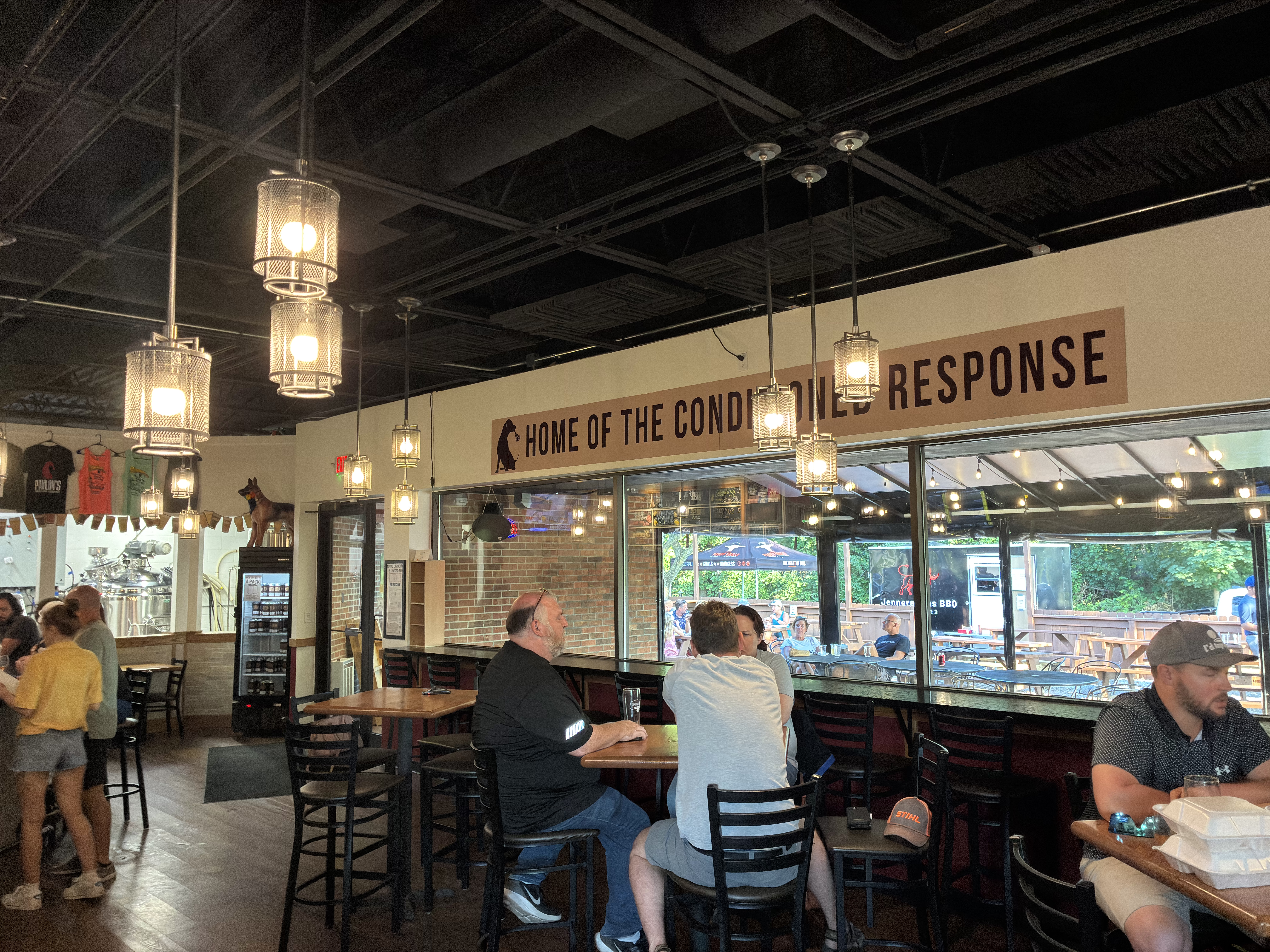
It is a tradition that my last blog entry of the year reflect upon the previous twelve months with a photo gallery of the breweries I visited during that period. In 2026, I visited a total of 35 breweries- 15in my home state of Ohio, 14 in other states, and 6 outside of the United States. The 14 breweries I visited in other states were located in California, Colorado, Michigan, Pennsylvania, and Utah, while those outside of the United States were in Armenia, Canada, Poland, and Slovakia. Of the 34 breweries 21 were ones I had visited before and 14 were first time visits (indicated in bold in the list below).
As per tradition, following the list below, I have included one photograph from each of the breweries I visited. Enjoy.
OHIO (15)
60cc Brewing, Toledo, OH
BJ’s Restaurant & Brewhouse, Toledo, OH
CLAG Brewing Co. Sandusky, OH
Great Black Swamp Brewing Co., Toledo, OH
Hoptometry Brewing, Tiffin, OH
Inside the Five Brewing Company, Sylvania, OH
Inside The Five Brewing Co., Toledo, OH
Inside the Five Brewing Co., Perrysburg, OH
Jackie O’s Pub and Brewery, Athens, OH
Maumee Bay Brewing Co., Toledo, OH
Old Dog Alehouse & Brewery, Delaware, OH
Patron Saints Brewery, Toledo, OH
Quenched & Tempered Brewing Co. Toledo, OH
The Laird Arcade Brewery, Tiffin, OH
Voodoo Brewing Company, Toledo OH
REST OF UNITED STATES (14)
Bell’s Eccentric Cafe, Kalamazoo, MI
Blind Lady Ale House, San Diego, CA
Dark Horse Brewing Company, Marshall, MI
Gordon Biersch Brewing Company, Romulus, MI (Airport Location)
Harland Beer Co., San Diego, CA (Bay Park Location)
Red Rock Brewery, Salt Lake City, UT (Airport Location)
New Holland Brewing Co., Battle Creek, MI
North Park Beer Co., San Diego, CA (North Park Location)
Pavlov’s Brewing Co., Temperance, MI
San Diego Tap Room, San Diego, CA
Seek Beer Co., San Diego, CA
Stone Brewing, San Diego, CA (Airport Location)
Vault Brewing Company, Yardley, PA
Woods Boss Brewing Company, Denver, CO
INTERNATIONAL (6)
Beer Academy Ethnograph, Yerevan, Armenia
Brovaria, Poznan, Poland
Pivovar Golem, Košice, Slovakia
Pivovar Hostinec, Košice, Slovakia
Steamworks Brewing Co., Vancouver, Canada
Yaletown Brewing Company, Vancouver, Canada
60cc Brewing, Toledo, OH
Beer Academy Ethnograph, Yerevan, Armenia
Bell’s Eccentric Cafe, Kalamazoo, MI
BJ’s Restaurant and Brewhouse, Toledo, OH
Blind Lady Ale House, San Diego, CA
Brovaria, Poznan, Poland
CLAG Brewing Co., Sandusky, OH
Dark Horse Brewing Company, Marshall, MI
Gordon Biersch Brewing Company, Romulus, MI (Airport Location)
Great Black Swamp Brewing Co., Toledo, OH
Harland Beer Co., San Diego, CA (Bay Park Location)
Hoptometry Brewing, Tiffin, OH
Inside The Five Brewing Co., Sylvania, OH
Inside The Five Brewing Co., Perrysburg, OH
Inside The Five Brewing Co., Toledo, OH
Jackie O’s Pub and Brewery, Athens, OH
Maumee Bay Brewing Co., Toledo, OH
New Holland Brewing Co., Battle Creek, MI
North Park Beer Co., San Diego, CA (North Park Location)
Old Dog Alehouse & Brewery, Delaware, OH
Patron Saints Brewery, Toledo, OH
Pavlov’s Brewing Co., Temperance, MI
Pivovar Golem, Košice, Slovakia
Pivovar Hostinec, Košice, Slovakia
Quenched & Tempered Brewing Co. Toledo, OH
Red Rock Brewery, Salt Lake City, UT (Airport Location)
San Diego Tap Room, San Diego, CA
Seek Beer Co., San Diego, CA
Steamworks Brewing Company, Vancouver, Canada
Stone Brewing, San Diego, California (Airport Location)
Earlier this summer I spent five days in Košice, Slovakia. I was there as a guest of the Technical University of Košice (TUKE) participating in a summer institute for PhD students. The focus of the institute was identifying and discussing those factors that can make cities more resilient in the face of challenges such as climate change, global health pandemics, geo-political conflicts etc. This was my second visit to Kosice in as many years, having participated in the same event last year.
Returning to Košice gave me the opportunity to catch up with Peter Škripko who owns Pivovar Hostinec, one of two breweries in the city. Pivovar, incidentally, is the Slovak word for brewery. Last year, I had spent a wonderful afternoon with Peter cycling around Košice with stop-offs at some of his favorite places to drink beer. This year, Peter picked me up from hotel in his beautiful Porsche. The first stop was Ovečka KE.CY Kiosk and beer garden, located in the Čermeľská Valley just outside the city. Starting just north of the city, the valley stretches 16km into forested hills. The 150-seater beer garden is popular with families who want to escape the city easily, as well as hikers who want some fresh air and exercise. The valley has been a destination for Košice residents since the 19th century.
According to its website, “the attraction of the kiosk are special draft beers”. The special draft beers in this case are brewed by Pivovar Hostinec. Indeed, the only beer sold at Ovečka is from Hostinec. Ovečka, in fact, is one of only two places, apart from the brewery, that sells Hostinec’s beer. The reason is simple – quality control. Based on past experience Peter is concerned about bars and restaurants handling his beer in such a way as to ensure it tastes as it should. This is an industry-wide concern. Issues that craft breweries face when others serve their beer include improperly maintained draft systems (i.e. dirty beer lines), dirty glassware, warm storage etc. The more bars and restaurants that sell a brewery’s beer the harder it is to maintain quality control. According to Julia Herz, Executive Director of the American Homebrewers Association, when the integrity of a beer is compromised “it’s very difficult to enjoy a beer as the brewer intended“. Peter wants everyone to enjoy his beer as he intended it to be enjoyed.
Ovečka KE.CY Kiosk
After a beer at Ovečka, we headed to Peter’s apartment where we had a light snack and a beer while enjoying a panoramic view of Košice from the comfort of his patio. The beer we had was a collaboration between Hostinec and Sibeeria Brewery in Prague in the Czech Republic. Called, “We Are From Exit” it was a delicious Double New England IPA, with an ABV of 8.2%. An interesting feature of this beer is its label, which was designed using AI. I wonder how common using AI to design labels is in the craft brewing industry. And will it become increasingly common in the future?
A panoramic view of Košice from the patio of Peter’s apartment
The label on this collaboration beer between Pivovar Hostinec and Sibeeria Brewery was designed using AI.
Following a beer at Peter’s apartment we headed, by foot, into the center of Kosice. The remainder of the afternoon was spent visiting some of the city’s best drinking establishments. As we walked around the city center, I was impressed with how many people Peter knew. He is clearly a well-established and well-liked member of Košice culinary scene.
Enjoying a beer with Eric, a bartender at one of Peter’s favorite beer spots
One of the places we visited was the other craft brewery in Kosice, Pivovar Golem. This was my first visit to this brewery. Curious about the name of the brewery, I learned that a golem is an anthropomorphic creature in Jewish folklore. It is often made from clay or mud. Perhaps the most famous golem narrative was written by the revered Yiddish writer I. L. Peretz in 1890. The setting for Peretz’s short story is the city of Prague in what today is called the Czech Republic. In the story, a rabbi (Rabbi Loew) brings a golem to life by placing a magic word in its mouth. At first, the golem protects the Jewish ghetto. One day, however, it flies into a rage and causes all sorts of physical damage, including the smashing of buildings. To put an end to the destruction, Rabbi Loew removes the word from the golem’s mouth, and it dissolves into dust. Shaken by the turn of events, Rabbi Loew promises himself never to bring a golem to life again. Today, it is said that the dusty remains of that particular golem are to be found in a closed-off attic of the Old New Synagogue in Prague.
The entrance to Pivovar Golem
The interior of Pivovar Golem
Peter at Pivovar Golem, with a golem in the background
It wonderful to be in the city of Košice again and to have the opportunity to spend an afternoon and catch-up with Peter Škripko. As always, Peter was amazingly generous with his time and treated to a wonderful tour of some of his favorite drinking places in the city. Walking is always a wonderful way to see a city and doing that walk with a native makes it even better. So, thank you to Peter for a wonderful afternoon. I hope we get the opportunity to do it again.
Earlier this year, I spent a week in the city of Košice in Slovakia. I was there participating in a week-long Summer Institute at the Technical University of Košice. The participants in the Summer Institute were faculty from nine countries and doctoral students from five countries. The event was described as a week-long bootcamp in which participants would explore, discuss, and debate “the X-factor of a city” – the X-factor being those characteristics and features of a city that contribute to it being high performing and making it a wonderful place to live and work.
Among other responsibilities, my participation in the event included giving an hour-long presentation on a topic of relevance to the bootcamp’s theme. My particular presentation focused on the role and importance of Third Places in the modern city. For those of you unfamiliar with the concept of Third Places, they are, to quote the urban sociologist Ray Oldenburg, “nothing more than informal public gathering places”. Much of my own research on the craft brewing industry has examined how craft breweries function as neighborhood Third Places in towns and cities across America. You can read some of my thoughts on craft breweries as Third Places here, here, and here. While my presentation included some discussion of the role of American craft breweries and British community pubs as Third Places, much of it focused on the concept of Third Places more broadly.
Getting ready to talk about Third Places at the Technical University of Košice
If you are unfamiliar with the city of Košice, it is the second largest city in the country and the largest city (population ~240,000) in eastern Slovakia. Dating back to the 13th century, the city has a long and fascinating history. At various times during its history, it was part of the Kingdom of Hungary, the Principality of Transylvania, the Austro-Hungarian Empire, and Czechoslovakia. Since the break-up of Czechoslovakia in 1993, it has been part of the Slovak Republic.
On the second to last evening of the bootcamp we had a farewell gathering. And guess what – this was held in a brewery. Pivovar Hostinec (Hostinec Brewery) was established in 2015 by Peter Škripko. It is housed in a building that dates to the second half of the 15th century. Originally a private residence, it was purchased by the city of Košice in 1569 and run as an inn. In 1617, a section of the building was leased and converted into a printing house; the first printing house in Kosice. Records indicate that part of the building was used as a brewery (the first in Košice) in 1604. The building was also the venue for the wedding festivities of Gabriel Bethlen, the Prince of Transylvania, and Catherine of Brandenburg in 1626. The marriage established an alliance between the Protestant Prince of Transylvania and the Protestant powers of Denmark and Sweden. This is certainly a building with a long and rich history. But that’s enough history. Let’s talk about beer.
Knowing my interest in craft brewing, the conference organizers asked me if I would be willing to collaborate with the brewery owner, Peter Škripko, and host a short but educational and fun presentation to kick-off the evening’s proceedings. Peter and I had a Zoom call and devised a plan of action. I would give a short presentation on the history of the craft brewing movement, after which he would provide an overview of the history of the brewery. Following that, Peter would lead the attendees through a tasting of four of the brewery’s beers.
Talking about the origins of the craft brewing movement at Hostinec Brewery
Peter led our group through a tasting of some of his brewery’s beers
Like many European craft breweries, Pivovar Hostinec, has a relatively small number of different beers on tap at any given time. Unlike many American craft breweries, which might have over a dozen different beers on tap, Pivovar Hostinec usually has six. The formal beer tasting was followed by a tour (and more tasting) of one of the brewery’s cellars where the fermentation tanks are housed. Not surprisingly, the evening was a roaring success, much of which was due to Peter’s vibrant and generous personality (and copious amounts of beer).
The evening finished with a tour of the cellars where Hostinec’s beer is brewed
Our group enjoyed the opportunity to tour Hostinec’s production space while sampling more beers
As I noted at the beginning of this blog entry, the aim of the week was to identify those characteristics and features of a city that contribute to it being high performing and making it a wonderful place to live and work. As the evening wound down, there were few of us who did not appreciate the role that Peter Škripko and Pivovar Hostinec play in enhancing the quality of life in the city of Košice.
Craft brewers are incredibly generous people. This generosity is manifest in a myriad of ways. As an example, take their efforts in support of charitable initiatives. While the data are rather dated, in 2016, American craft breweries donated an astonishing $73.4 million to charities. Many of these dollars benefited organizations in their own communities and, by extension, local residents. In 2019, 95 craft breweries in the state of Minnesota who responded to a survey, reported contributing $874,310 to 3,000 community and charitable organizations.
In the 10+ years I have been studying the craft brewing industry I have also found craft brewers very generous of their time when I have asked them for an interview or tour of their brewery. This does not surprise me. Craft brewers are passionate about their profession and are very happy to make the time to share that passion with you.
Recently I experienced an unprecedented example of craft brewer generosity. I was in the city of Košice in Slovakia to participate in a Summer Institute at the Technical University of Košice (TUKE). Prior to my visit my friend and colleague, Oto Hudec (who is on the faculty at TUKE) had connected me with Peter Škripko, the owner of Pivovar Hostinec, one of two breweries in the city. Peter offered to give me a tour of both his brewery and the city, including a visit to some of his favorite craft beer bars.
Peter and I had arranged to meet after lunch on a Wednesday afternoon. During lunch, Oto got a telephone call from Peter, asking if I would be comfortable touring the city by bike rather than by foot. This would allow Peter to provide me with a geographically more expansive tour of the city. When Oto asked me about the possibility of touring by bike, I must admit that I hesitated. You see, I had not ridden a bicycle since I was teenager, over 40 years ago. Despite my hesitation, I agreed to undertake the tour by bike. After all, riding a bike must be just like “riding a bike” – if I had done it before, I could surely do it again.
Peter picked me up in his car outside the restaurant where I had lunch and drove me to his brewery. Her fixed me up with one of the brewery’s bikes and after some adjustment to the saddle we were ready to go.
Bike tour of Košice with Peter Škripko
My first time riding a bike in over 40 years
As with many European cities I have visited, Košice is bike-friendly, with ample bike paths. Peter proved to be a fantastic tour guide. This was the city of his birth, and he knew a great deal about its history. He also knew the best places to get a craft beer, and we had numerous refreshment stops during our 8km+ ride.
We made several stops for beer during our bike tour of Košice
Our penultimate stop before arriving back at the brewery was Camelot Restaurant, also owned by Peter. At Camelot, under Peter’s watchful eye, I had the opportunity at trying my hand at pouring (tapping) some Pilsner Urquell. Pilsner Urquell, of course, is famous as being the original pilsner beer, having been first brewed by brewmaster Josef Groll in 1842 in the city of Plzeň in the Czech Republic.
Peter knows a thing or two about Pilsner Urquell. In 2011, he won the national competition to become Slovakia’s Pilsner Urquell Master Bartender. The competition tested not only Peter’s ability to pour and serve a glass of Pilsner Urquell, but also his ability to communicate effectively with customers, and his knowledge of the history of the famous beer. Winning the national competition made Peter eligible to represent Slovakia in the international bartender competition, where he placed an impressive third.
In 2011, Peter became Slovakia’s Pilsner Urquell Master Bartender. This poster in Camelot highlights this achievement
There are three ways in which Pilsner Urquell can be served – Hladinka, Šnyt, and Mlíko. The standard pour is the Hladinka, which has “three fingers” of foam atop the lager. The Šnyt (pronounced ‘shnit’), is two parts beer, three parts foam and one part empty space at the top of the glass. The Mlíko is a glass of foam, with just a small amount of beer at the bottom. Each pour type is created to pair with different foods. The Hladinka pairs well with rich foods like duck, theŠnyt with hearty food like goulash or a burger, and the Mlíko with dessert.
The three ways in which Pilsner Urquell can be served – Hladinka (left), Šnyt (center), and Mlíko (right). Photo source: PilsnerUrquell.com.
Peter and his bartenders demonstrated the different pours to me and then gave me the opportunity to try my hand. You can judge how successful I was by the video posted here
Enjoying the fruits of my labor with two of Camelot’s wonderful bar staff
Enjoying another Pilsner Urquell with Peter
The following day I met up with Peter again, this time at his brewery. We were going on another tour. This time it was on foot, however, and involved going no further than the cellars of the brewery where Hostinec’s fermentation tanks are housed. Once there, I spent a glorious couple of hours with Peter talking about our common passion for the liquid nectar, while sampling at least a dozen different beers straight from the fermentation tanks.
The day after our bike tour, Peter gave me a tour (and a taste) of his production space
One of the dozen or so beers I sampled while touring Peter’s production space
As I said in my introduction to this blog entry, craft brewers are generally very generous individuals. But Peter Škripko took that generosity to a whole new level when he spent a significant chunk of time with me on my visit to Košice. Thank you, Peter, for being such a generous host.